Thursday, July 20, 2006

Binnall Reviews Stanton T. Friedman is Real

I was surfing the "dreaded Internet" tonight, and popped by Binnall of America. I wandered into Tim's "Past Columns" section, and lo and behold, there was a review for my first film as a director, Stanton T. Friedman is Real. Who knew?

Anyway, Tim liked the film, so I'm happy to provide a link to the review, which can be found here (you can find negative reviews of my work on your own - hahahaha...).

Here's an excerpt:

If you are familiar with Stanton Friedman's work, but not the man himself, this is a must see film. It is certainly far different from any UFO films I've seen as this one focuses on the man himself and not the "lights in the sky" that have been the subject of films ad nauseum. Worthy of note is that it also makes an
excellent starting point for anyone trying to introduce UFOs to their "noisy negative neighbors" or family. Friedman comes out of the film with high credibility that transfers over to Ufology and, thusly, may help an uneducated doubter to finally muster, "There may be something to this, after all.

Tim Binnall is clearly a perceptive young man, with a bright future ahead of him!

Thanks for the kind words, Tim.

Paul Kimball

Sunday, July 16, 2006

2006 New Frontiers Symposium

Well, we now have a name for the symposium in October...
The 2006 New Frontiers Symposium
Extraterrestrial Life, Space Exploration & The Future
We've also adopted a motto:

The only way to discover the limits of the possible is to go beyond them into the impossible

Will Wise and I will have the website finalized sometime this week (he's doing all the hard work - I'm just offering the odd comment). When it's up and running, I'll let you know.
All very exciting.
Paul Kimball

Thursday, July 13, 2006

The Posthuman Future, Vol. I

This is pretty amazing.

Paul Kimball

Paralyzed Man Moves Cursor Through Thought

By PATRICIA REANEY, REUTERS

LONDON (Reuters) - A Paralyzed man using a new brain sensor has been able to move a computer cursor, open e-mail and control a robotic device simply by thinking about doing it, a team of scientists said on Wednesday.

They believe the BrainGate sensor, which involves implanting electrodes in the brain, could offer new hope to people Paralyzed by injuries or illnesses.

"This is the first step in an ongoing clinical trial of a device that is encouraging for its potential to help people with paralysis," Dr Leigh Hochberg, of Massachusetts General Hospital, said in an interview.

The 25-year-old man who suffered paralysis of all four limbs three years earlier completed tasks such moving a cursor on a screen and controlling a robotic arm.

He is the first of four patients with spinal cord injuries, muscular dystrophy, stroke or motor neurone disease testing the brain-to-movement system developed by Cyberkinetics Neurotechnology Systems Inc. in Massachusetts.

"This is the dawn of major neurotechnology where the ability to take signals out of the brain has taken a big step forward. We have the ability to put signals into the brain but getting signals out is a real challenge. I think this represents a landmark event," said Professor John Donoghue of Brown University in Rhode Island and the chief scientific officer of Cyberkinetics.

The scientists implanted a tiny silicon chip with 100 electrodes into an area of the brain responsible for movement. The activity of the cells was recorded and sent to a computer which translated the commands and enabled the patient to move and control the external device.

"This part of the brain, the motor cortex, which usually sends its signals down the spinal cord and out to the limbs to control movement, can still be used by this participant to control an external device, even after years had gone by since his spinal cord injury," added Hochberg, a co-author of the study published in the journal Nature.

Although it is not the first time brain activity has been used to control a cursor, Stephen Scott of Queen's University in Ontario, Canada said it advances the technology.

"This research suggests that implanted prosthetics are a viable approach for assisting severely impaired individuals to communicate and interact with the environment," he said in a commentary in the journal.

In a separate study, researchers from Stanford University Schools of Medicine and Engineering described a faster way to process signals from the brain to control a computer or prosthetic device.

"Our research is starting to show that, from a performance perspective, this type of prosthetic system is clinically viable," Stephen Ryu, an assistant professor of neurosurgery at Stanford, said in as statement.

Tuesday, July 11, 2006

"I Fought the Law"... Vol. V

In 1950 Nicholas Mariana filmed what some people still consider to be footage of two unidentified flying objects (this is the famed Great Falls UFO film). Others think he merely filmed a couple of high flying USAF jets. See this article for a synopsis of the story.

Either way, most people within ufology know about Mariana's film. Fewer people know that a year later he sued Cosmopolitan Magazine for libel as a result of an article it ran on UFOs that mentioned him.

He lost, which was the proper decision. Note, however, that the impugned language was clearly considered libellous by the Court.

Paul Kimball

Case Name: Mariana v. Hearst Magazines, Inc.

MARIANA v. HEARST MAGAZINES, Inc., et al. 122 F. Supp. 506; 1954 U.S. Dist.

UNITED STATES DISTRICT COURT FOR THE SOUTHERN DISTRICT OF NEW YORK July 12, 1954

Counsel:
Parker, Duryee, Benjamin, Zunino & Malone, New York City, for plaintiff.
McCauley & Henry, New York City, for defendants.

Opinion by:
EDELSTEIN

Opinion:

In an action for libel, defendants move for dismissal on the ground that the complaint fails to state a claim upon which relief can be granted. The publication complained of appeared in the 'Cosmopolitan' magazine of the defendant Hearst Magazines, Inc., and was entitled 'The Disgraceful Flying Saucer Hoax.' The article treated of the fraudulent character of reports of 'flying saucers' and attributed to 'pranksters, half-wits, cranks, publicity hounds and fanatics' the creation of public fears and the cause of great public expenditures in the investigation of reports of 'purely idiotic and wholly nonexistent' craft. But in the middle of the piece it was stated that 'There can, of course, be honest mistakes.' Following is an account of an innocent mistake. Immediately after that three-paragraph account, there appear three paragraphs describing an incident involving the plaintiff, who is named. In the paragraphs relating to him he is not characterized and on its face that material is not defamatory.

The defendants address themselves to the three paragraphs specifically discussing the plaintiff, in isolation from the remainder of the text, and argue that a defamatory meaning is imputed to the language by an innuendo which connects these paragraphs with other unrelated portions of the article; thus, the plaintiff is attempting, improperly by innuendo, to distort and amplify into libel language in itself devoid of actionable meaning. And since the plain obvious meaning of the language cannot be altered by innuendo, Fleischmann v. Bennett, 87 N.Y. 231, the complaint must fall.

But the plaintiff does not rely on innuendo. He alleges that, considering the article as a whole, as it must be considered, Kloor v. New York Herald Co., 200 App.Div. 90, 192 N.Y.S. 465; Klaw v. New York Press Co., 137 App.Div. 686, 122 N.Y.S. 437; those portions treating of persons derogatorily characterized may be fairly read as applying to him, thus constituting the libel. There can be no doubt that if such portions do apply to the plaintiff, the language is libelous on its face and no innuendo is required to explain the defamatory meaning.

The problem, then, is whether the article can be fairly read as applying the force of its barb to the plaintiff. '[The] language is to be construed fairly and naturally. It is not enough that a critic or a malignant may torture the expressions into a charge of criminal or disgraceful act. Nor is it enough, on the other hand, that a possible and far-fetched construction may find an inoffensive meaning in the language. The test is whether, to the mind of an intelligent man, the tenor of the article and the language used naturally import a criminal or disgraceful charge.' More v. Bennett, 48 N.Y. 472, 476. By this test, I have no doubt that even the casual reader could come to no other conclusion than that the article classes the plaintiff as one who was the victim of an honest and quite reasonable mistake to which no opprobrium could be attached. The treatment of the plaintiff is in stark contrast to the treatment of those who are alleged to be motivated by fraudulent and improper intentions, and any confusion between the two may be accomplished only by torturing the language.

The motion will be granted.

Saturday, July 01, 2006

My Alma Mater... On Mars?

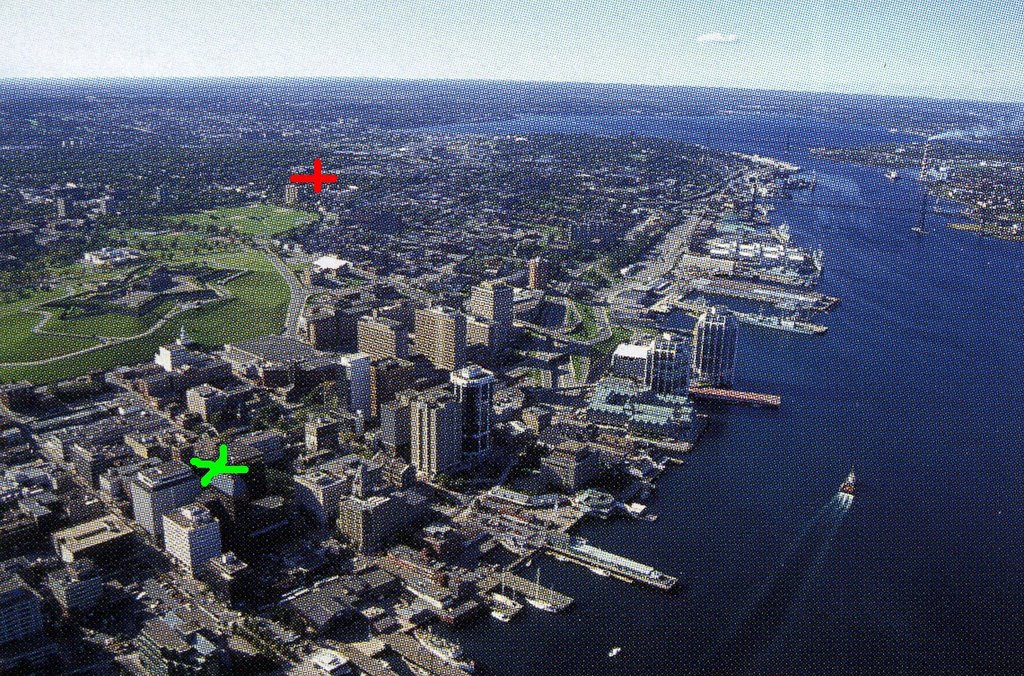
Well, not yet... but soon, my alma mater (law school), Dalhousie University here in Halifax, will have a presence on Mars, through their participation in the Phoenix Mars Scout.

The Mars Scout is a joint project between the Canadian Space Agency and NASA to investigate the water cycle on Mars. The Canadian contribution to the mission will be an automated weather station, including a small lidar system. The spacecraft will launch in August 2007 and land in May 2008.

You can get more information on the mission, and Dalhousie's role, here.

Pretty cool stuff.

Paul Kimball

Wednesday, June 28, 2006

Ufology - Onward and Upward

A. J. Gulyas is an interesting new-ish voice on the UFO scene. Here's an excerpt from his latest (the entire post can be found here):

I’m working up to something here–much of my reading and listening over the past six months or so has focused on the idea of “others” being here on Earth (extradimensional, cryptoterrestrial, whatever you want to call it). This isn’t a new idea in UFOlogy, but it’s one that hasn’t been talked about loudly or by the usual talking head subjects. I’m particularly fascinated by the idea that this could finally solve the mystery of the Contactees, which is the area where I’ve done most of my work.
Oddly enough, my thinking on this was sparked by some passages about Richard Shaver in, of all things, They Knew Too Much About Flying Saucers by the late, great, Gray Barker.

So anyway, I’m trying to put together some sort of narrative scenario, a story, which might tie these threads to the Contactees, as an intellectual exercise not a serious theory. There are deeper guys than I doing that right now (Mac Tonnies, for one). I find it interesting that even though there are a number of people who have thought and are thinking along these lines, the UFOlogical mainstream is still focused on the ETH with an almost frightening single-mindedness.
Frankly, the question of whether ufology should be looking for more cases, or trying to grapple more with the various theories, is an interesting one.

Of course new cases should be investigated (although there are still plenty of old cases, particularly in the Blue Book files, that have yet to be properly investigated). But there seems to be an assumption that anyone can adequately investigate cases, interview witnesses, compile data, and examine that data. In my view, that's just false. You need intelligent, properly trained and supervised people, working within a well-defined methodology (i.e. professionals), in order to accomplish anything meaningful. That just doesn't exist these days, in large part because there's no money for it.

How about the suggestion that a civilian group could somehow "track" UFOs using modern technology? Unless the effort has significant institutional funding, you can place it in the same category as the amateur investigation of cases noted above. After all, if the Air Force and civilian aviation can't get a bead on UFOs (and they can't), I doubt Joe and Jane are going to be able to do it. No matter how sophisticated their equipment is, it isn't as good as the stuff that the military is using, and has been using. The main benefit to this approach, as I see it, would not be in the actual results, but in the "gee whiz" factor, i.e. the use of technology, which might encourage younger people to take an interest in the subject. That might bear some long term fruit, but of a different sort than the proponents of this idea might intend. Still, there's no harm in trying.

It's not like there's nothing happening, after all. There's no shortage of footage and photos popping up that can be analyzed, given proper resources and knowledge. There are still plenty of witnesses who can be interviewed, and lots of old cases that can be investigated, or re-investigated. In short, there's still lots to do. But I think one has to realistic about the prospects of any success under the status quo, or even under some of the proposed alternatives. Above all else, any future investigation needs to be an organized, properly funded effort, if it is to accomplish anything meaningful.

In the meantime, there's already an impressive body of data extant that indicates UFOs are a real phenomenon. Perhaps the real work to be done is in further refining, and / or deconstructing, the various theories as to what UFOs (or UAP, as NARCAP would say) might be. That's something that would, I think, be more likely to engage the kind of bright young minds that ufology needs if it is ever to progress. Extra-dimensionals? Extra-terrestrials? Time-travelers? Unknown atmospheric phenomena? There's a reasonably good (at least in the theoretical sense) case to be made for all four. Cryptoterrestrials? Perhaps. We'll have to wait and see where Mac Tonnies (and others, probably), go with it, and how he uses the evidence to support his theory.

In this regard, let Stan Friedman retire the "Cosmic Watergate" lecture, and dust off the "flying saucers and physics" lecture. Here's how it starts (I've heard him give it): "UFOs are real. Some are alien spacecraft. I'm going to show you how that is possible." Then let the debate begin, as it did once at Acadia University, twenty years ago, when Stan mentioned flying saucers and physics as part of a more general lecture. In the Q & A session afterwards, a group of young science students challenged him afterwards on the accuracy of... well, his science. Stan, of course, responded, and there was, as I recall, an interesting, if all too brief, dialogue. Most of the budding young scientists seemed to leave unconvinced, but they also seemed genuinely interested, and intrigued, not by the talk of grand government cover-ups, but by the possibilities inherent in the UFO phenomenon - just as guys like A. J. Gulyas are today.

So, in conclusion - continued investigation? Absolutely, although it needs to be done in a more organized fashion, and more objectively, i.e. without any pre-conceived notions, if it is to offer anything of real use to the existing body of knowledge. However, the truly interesting stuff, more and more, is not about just the investigation of the phenomenon, but rather the questions of "what", and "how". .. and perhaps even "why".

Paul Kimball

Tuesday, June 27, 2006

UK Trip Photos, Vol. III

Here are some more train-related photos from the United Kingdom.

Here's Zorgrot on the train as we get ready to depart London (Euston station) for Manchester (Picadilly station).

While he obviously found trains to be primitive modes of transport, compared to his interstellar spacecraft (with transdimensional overdrive, no less), he was still impressed by the comfort, the fact that they pretty much ran on time, and the nice view out the window. He took a lot of notes as we zipped through middle England.

Here's a pic of platform number 10 at Manchester's Picadilly station, where we arrived from, and departed to, London (and Blackpool, when we took our day trip). Like all British train stations (at least the ones I was in), it was clean (except for the tracks themselves), well laid out, and easy to use.

The only down side? An incomprehensible lack of any trash cans. Instead, janitors / cleaners came by every now and then with moving trash bins and picked up the rubbish. Weird.

If you want to walk the UFO trail at Rendlesham, and you're headed up that way by train, Woodbridge, the nearest town, will be your stop. This is what the station looks like. The town itself is lovely - very charming, in a stereotypically English way.

Paul Kimball

Dumbing Down Docs - Who To Blame??

Author John Shirley on documentaries:


Incredibly Annoying, Insulting Documentary Editing

There's a trend to edit documentaries--even the more serious ones involving history and science--with editing tricks that “jolt“ the viewer with suddenly-sped-up motions, deliberately wrenching cuts, abrupt switches in camera viewpoint, spastic camera motion, etc etc etc, to try and give the film a “sexy“
high energy feeling. This is an expression of the film maker's assumption that you're stupid and lazy and you suffer from Attention Deficit. You don't have the attention span to watch a documentary that flows, that is rationally cut together. You need to be babied along, like someone snapping their fingers or
jingling keys to get an infant's attention. Ken Burns didn't have to do it, and his stuff is successful. No one has to do it. It's a degradation of the culture of documentary film making."

Mac Tonnies chimes in:

Anyone who's suffered through a typical UFO documentary (say, the ones on the Discovery Channel) will immediately know what Shirley's talking about. The rules seem to be:

1.) Assault the viewer with lots of randomly inserted stock footage from little-known 1950s sci-fi movies.

2.) Go for lots of "moody" lighting that makes speakers seem like they're tuning in from another dimension. This gives them a suitably "spaced out" appearance and helps ensure that they won't be taken seriously.

3.) Employ dumb sound effects. Whirring, beeping, humming. You know, "space" sounds!

4.) Show the archetypical "Gray" alien visage as often as
possible, regardless if the documentary is actually addressing aliens. Space exploration, extraterrestrial intelligence, UFOs -- it's all the same, so who cares?

There's some truth to this, no doubt , although there are notable exceptions (Burns is one, Errol Morris is another). Let me suggest a few reasons why, however - not all of which are the fault of the filmmaker, or the network that commissions the film:

1. Blame, to some degree, music videos, which changed the way people perceived not only music, but also television and film.

2. Blame the viewers as well - if filmmakers are insulting their intelligence, that's because these people want to be insulted, or can't tell the difference anymore.

3. Finally, blame the filmmakers and the networks, for taking the easy way out, instead of making challenging films (and I speak here about subjects other than just UFOs and the paranormal as well).

I liken a good documentary to good sex, where faster / quicker is not necessarily better.

A good documentary should have plenty of foreplay (what I like to call the "slow reveal"), some genuine suspense, and a narrative structure that actually tells a story, whenever possible.

As for stock footage, avoid it like the plague. I've never used a single second, and I wouldn't, unless the images were directly related to what was being talked about at the particular moment on the screen - for example, footage of an exploding A-bomb would be fine if you had Stan Friedman talking about aliens being in New Mexico in 1947 to monitor atomic tests, or something like that.

Finally, and this a factor overlooked, I think, by both Shirley and Tonnies, blame ever-decreasing budgets (largely the result of the proliferation of channels without a concomitant increase in the pool of potential advertisers). Travel is expensive. Paying crew is expensive (even my habitually underpaid gang of misfits). Stock footage, while it can sometimes be expensive to acquire (although not always), is usually a cheaper alternative, particularly compared to re-creations (if you want to do them well).

Anyway, things won't change much until people start demanding that they change, which I don't expect to happen anytime soon, at least not in the numbers required to make a difference. Vox populi rules, and, as with modern pop music (Britney Spears etc.), the public seems perfectly happy with the re-cycled, dumbed-down, Coles-notes version that they're getting.

Meanwhile, I'll keep trying to buck the trend, and - within the budgets I have to work with (note to the Canadian networks - I'm not complaining!!) - create films that inform and entertain at the same time.

Paul Kimball

UK Trip Photos, Vol. II

Here are some more pics from my recent trip to London.

This first one I call "Bad Parent". Here in Nova Scotia, smoking isn't outlawed (what you do in the privacy of your own home, or in the great outdoors, is your own business), but try lighting up in a public place (like, say, an airport), and you're asking for trouble, and a ticket. Proper thing, in my view. The British, alas, take a more "libertarian" view of smoking, to the point that the smoking section in bars and pubs is indistinguishable from the non-smoking section, and thus pretty much useless (here, our smoking rooms - or pre-cancer wards, as I call them - are well segregated and totally, hermetically, sealed). Anyway, the photo above is a shot from Gatwick International, up by the food court, of the "smoking enclosure", where addicts (sorry, smokers) wander in to light up one for the road (or several - some never seemed to leave). The little girl you see waiting just outside was told to hang there while Dad had three cigarettes inside (by the way, in case you're wondering, she was not with that lady and the baby to her immediate left - she was alone there). Boo, hiss!

I love train stations - always have, always will. For some reason, they seem much more civilized than airports, which might have something to do with the fact that I don't have to take half my clothes off to get on one, and I don't have to wait forever to retrieve my luggage. Further, a trip on a plane just seems to me to be a means of getting from Point A to Point B, but a trip on a train, well, that seems like an adventure. On a train, you're not soaring above the Earth like some sort of god - you're down here, passing by the countryside, stopping in at new places on your way (more places on some trains than others). It's similar to the difference between Interstates and older highways, or, in superhero terms, Batman (trains) and Superman (planes). Don't get me wrong - I like airplanes and Interstates (and Superman), especially for longer trips like those we have here in North America, because they're convenient. But sometimes it's nice to take the long way around, so to speak, and to see more of the real world. Anyway, this is a shot of Liverpool Street station, where we caught a train up to Woodbridge, near Rendlesham. It was the nicest of the big London stations I was in.

Paul Kimball

Veronica Reynolds UFO Fan Club - Vol. IV

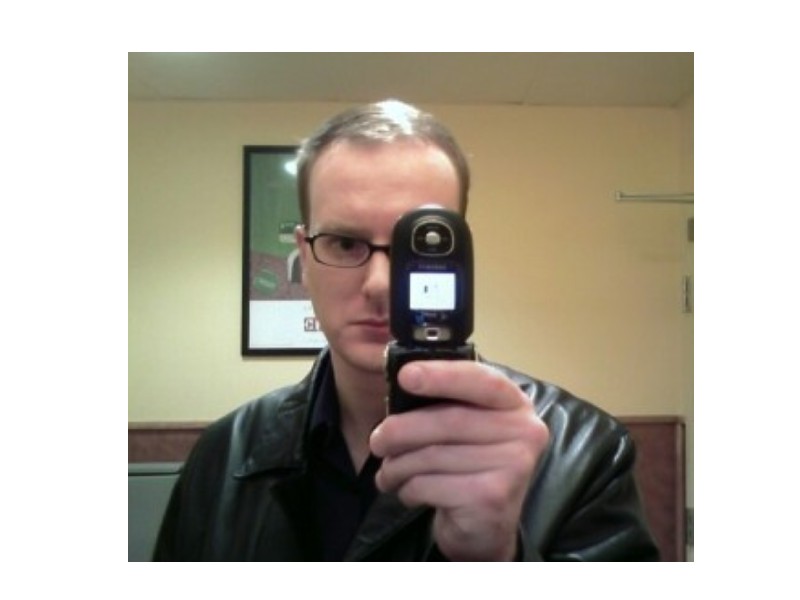
Ahh, what the heck... one more VR photo, courtesy of Mac Tonnies, who took it on his cell phone at a hotel bar in Santa Ana back in May (Embassy Suites, I think), when the three of us went out for a few drinks, and wound up at an after-party for some wedding on the 6th floor. Mac and I got ditched by VR and wound up talking to some guy for two hours about comic-book heroes, all while he tried to demonstrate his black belt kung fu (or whatever) techniques on me. Unfortunately, he had been drinking heavily, so when he'd give me a chop (or whatever), despite his claims to be able to pull his punches... well, let's just say that I politely tried to keep him from demonstrating the "Iron Fist Killing Blow" on my throat!

It was an experience as surreal as any UFO sighting!!

Paul Kimball

Veronica Reynolds UFO Fan Club - Vol. III

It's been a while since the last instalment of the Veronica Reynolds UFO fan club, and I feel a bit guilty that I've been giving Amy all the publicity lately, so here is Vol. III of the VRUFOFC, especially for Mac Tonnies!

Veronica returns to Nova Scotia this weekend from her acting studies in Los Angeles (she's been at the Actor's Studio for a couple of months), where she got to meet, and hang out with, the likes of Al Pacino. Production is heating up in Halliwood for the summer, and I suspect that she's going to be in demand. Also, keep an eye out for her in the forthcoming Trailer Park Boys movie, due out sometime in the fall.

It'll be great to have VR back in town - assuming she'll still return my calls after her stint in La La Land!!

Paul Kimball

UK Trip Photos, Vol. I

Here are some pics from my trip to the United Kingdom from the 8th until the 15th of June.

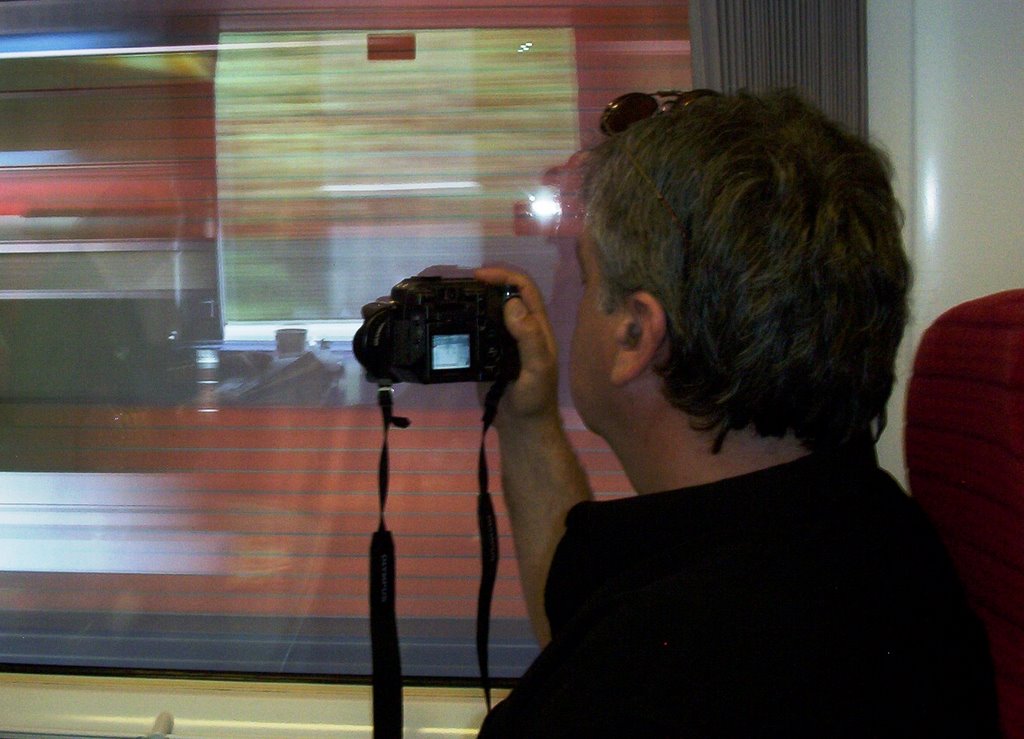
This is one that I like to call "Photographing the Photographer" - Findlay Muir getting ready to take a shot out the window as we hurtled along on the incredibly convenient Gatwick Express, from London's Victoria Station direct to Gatwick airport (we North Americans could learn a lot about mass transit from the British).

In this one you can see what a three star hotel room looks like in London (the My Place Hotel). Plusses - only about 75 yards from Earl's Court underground station, nice neighbourhood with several places that had public internet access (something else we North Americans could learn from the British), friendly staff, well-maintained property, and a great price for being in central London (about $95 CAD per night). Minuses - no air conditioning (definitely something the British could learn from us), although you did get a fan, and the windows opened (but when it's 28 degrees centigrade, that doesn't help much), and a small bathroom... er, toilet (but, as it was "en suite", I'm not going to complain). All in all, a very good, if somewhat sweaty, experience.

Finally, here's Rear Admiral Zorgrot in Blackpool, a wonderful seaside city north of Manchester that resembles Atlantic City. Tons of fun, and kitsch, and a small diner that made a great meat and potatoes pie (I may be the only person in the world who thinks the British have the greatest cuisine ever). Zorgrot quite enjoyed the ocean breeze, which helped his hay fever... at least for a while.

More to come. Stay tuned.

Paul Kimball

Please Send Money!

Please send money - Linda and I are running low on cash, and she's been reduced to gathering pop cans and beer bottles for recycling!

Apparently I'm just not making enough money from exploiting the UFO community for my films. I must try harder to be evil - otherwise she and I will never be able to afford that vacation to Moncton!

Paul Kimball

A UFO Over Altrincham?

I'm finally one up on Stan Friedman, who has never seen a UFO.

Or am I?

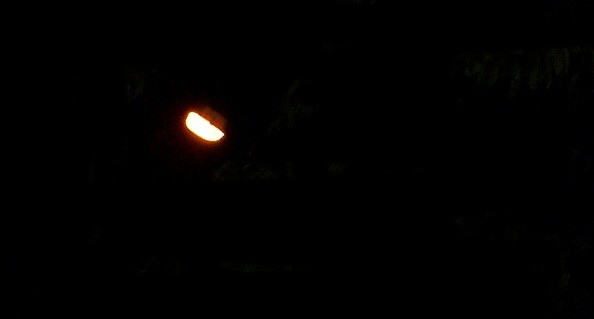
While Nick Redfern and I were sitting with Stuart Miller on his back porch on the evening of Saturday, the 10th ofJune, waiting to do the Strange Days... Indeed show, at around 10 pm GMT we saw an unidentified flying object! I managed to grab a picture with my camera just before it disappeared.

Here is the photo I managed to take on my digital camera. This was definitely not an aircraft. Could it have been an extraterrestrial vehicle?

Opinion differed between the three of us. Stuart thought that it was an extradimensional manifestation of a paranormal intelligence... or something like that.

Nick was convinced that it was an illegal uber top secret British experiment using captured German soccer hooligans to test the effect of post-World Cup traumatic stress disorder on monkeys... or something like that.

I figured it was an atmospheric phenomena that had yet to be identified, or that we were simply misperceiving some natural phenomena, while at the same time not ruling out an ET spacecraft... hopefully one carrying beautiful Plejaren babes.

Of course, it was none of those things. It was, in fact, something pretty mundane. Kudos to the first person who correctly identifies the "object" (and no, Kyle, it wasn't a model train wheel covered with fluorescent paint).

Paul Kimball

Tonnies and the Crytpoterrestrials

Mac Tonnies is continuing to refine his cryptoterrestrial hypothesis over at his blog, Posthuman Blues. If you haven't been following along, you should. Here's an excerpt from the latest instalment:

If my hypothetical indigenous humanoids practice telepresence at the neurological level -- perhaps by manipulating the electromagnetic fields that constitute "consciousness" -- the implications are far more disturbing than one might think. The ability to transfer "souls" entails the possibility of "possession." It also allows for "Walk-Ins" and "Wanderers," New Age terms for alleged noncorporeal aliens who take command of human bodies. Taken to its logical extreme, "biological telepresence" offers an expansive -- if tentative -- explanation for myriad "occult" phenomena. It potentially explains why we seldom see the cryptoterrestrials in the flesh: If they've mastered the technique of projecting themselves into our world from the safety of their enclaves, they'd have little reason to "mingle" with us unless compelled by an important purpose."

A. J. Gulyas had this to say about Mac's theorizing:

This Cryptoterrestrial thing that Mac Tonnies is working on is really starting to take the form of something that will be spoken of in the same tones as the ETH, extradimensional hypothesis, etc. It ties into so many long-standing esoteric themes – contactees, Shaverian Devos, fair-folk, etc.– so
well. It’s very exciting, as good ideas often are."


The cryptoterrestrial idea is interesting... espeically as it ties together, as A. J. notes, many disparate elements (a unified-field theory for ufology in the making?? ). I'm an ETH guy (as far as theories go), but I'm willing to follow along, and watch as this new theory develops before our eyes. Let's see where it goes, and what evidence Mac musters to support it.

A. J. is a bright guy, too - check out his blog, which is listed on the sidebar (or you can link to it here).

Paul Kimball

Peter Gersten on Contemporary Ufology

Peter Gersten, one of the co-founders of Citizens Against UFO Secrecy (CAUS) back in the 1970s, had this to say at his website today. It's an in interesting perspective on the recent Space.com article "UFO Research: Findings vs. Facts" that I linked to here a couple of days ago. Peter states:

"UFOs: THE CONTROVERSY CONTINUES
Reluctantly I have to agree with Robert Sheaffer when he states that UFO believers are convinced that the existence of UFOs will be revealed 'any day now'. But it's like Charlie Brown and the football: No matter how many times Lucy pulls the football away—or the promised 'disclosure' fails to happen—they're dead-certain that the next time will be their moment of glory. I know several UFO "experts" who still cling to this hope. I guess they have nothing better to do with their time than believe in a practical impossibility. But as long as there are people like Ted Roe - Executive Director of the National Aviation Reporting Center on Anomalous Phenomena (NARCAP) - there is hope that scientific documentation - if not an absolute explanation - will one day be forthcoming about some of the UFOs that plague our skies. I have also read a recent commentary by a UFO extremist criticizing the below article for its many omissions while also alleging that Space.com is acting in support of the information embargo about an Extraterrestrial presence on Earth. Besides assuming something not based upon credible evidence (an ET presence) our UFO researcher destroys his own credibility with paranoid accusations which are far less believable than the article he attacks. Ufology is quickly becoming the new religion – with UFO researchers - who continue to espouse science fiction as fact – its disillusioned High Priests." [original
here]

As I said, an interesting perspective, about an interesting article, from an interesting guy, who has walked the walk.

Paul Kimball

Monday, June 26, 2006

Rendlesham Case Solved?

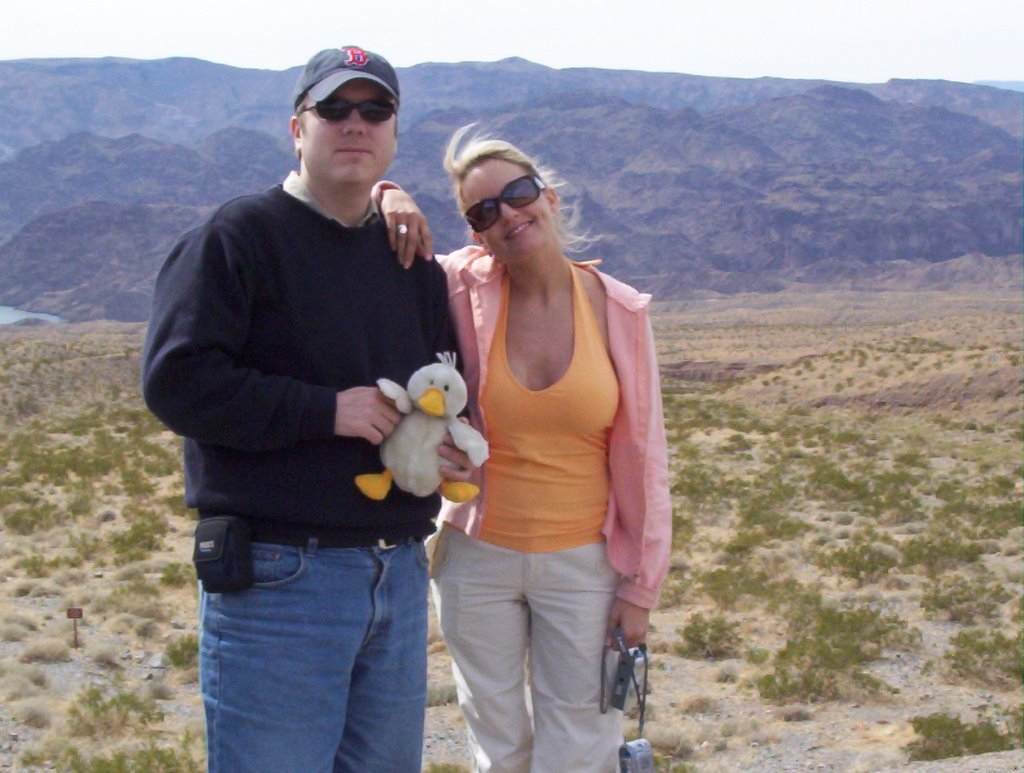
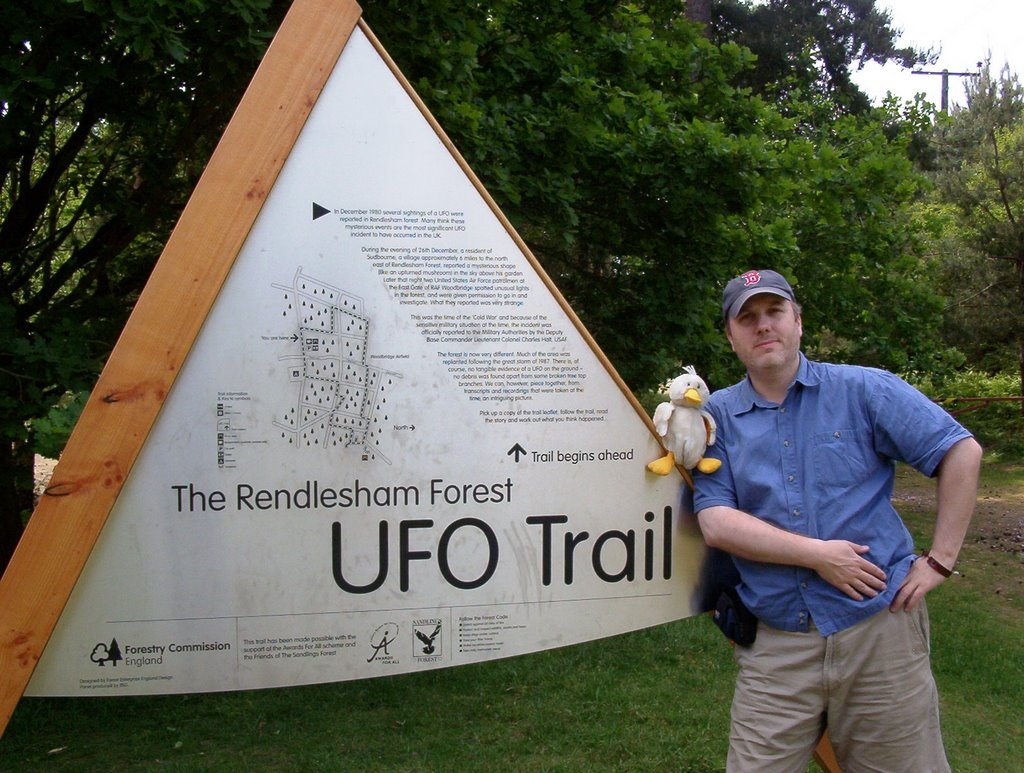
Zorgrot and I at Rendlesham, United Kingdom. Zorgy swears he had nothing to do with the Rendlesham case (he was still at the Academy back in 1980) - he says it was a couple of frat boys on a university study mission from Zeta Reticuli Prime who got drunk and decided to buzz the natives.

Who knows?

Paul Kimball

The Other Side of... Karl Pflock (Part I)

Back in September, 2001 (just two days before 9/11), I had the opportunity to meet and interview Karl Pflock in Cedar Rapids, Iowa, for the film Stanton T. Friedman is Real (I also interviewed Kevin Randle for the first time that weekend). The interview with Karl lasted about three hours, of which maybe four or five minutes finally made its way into the film (that's how it goes). Here, in an ongoing series, is the entire interview - first up, Karl offers a bit of background on himself, and then talks about the state of ufology.

Paul Kimball

The Other Side of… Karl Pflock (Part 1)

Q. Name, rank and serial number.

A. I’m Karl Pflock. I’m an author and ufologist. I have been actively involved in and interested in UFOs literally since I was a child. I’ve done other things in my life as well. I was a senior congressional staffer for a number of years with Jack Kemp and another congressman named Ken Kramer. In fact, when I worked for Ken I was the guy who organized the first actual hearings on “Star Wars” – much to the chagrin of the Reagan administration. [laughs] We were supportive, but they didn’t want to come up there that soon. I was an intelligence officer with the CIA before that, back in the ‘60s. I went from Capitol Hill to the Reagan administration as a Deputy Assistant Secretary of Defence for operational tests and evaluations, where I had a title that goes even longer than that, and, since 1992, I have been a full-time freelance writer, in all sorts of things, not just ufology, but unfortunately a large chunk of my life over these past nine years has been Roswell.

Q. And you are involved with MUFON in some capacity, right?

A. I am a state section director, as they call it, for MUFON in New Mexico, which means that I have the responsibility for a couple of counties in New Mexico where nothing is happening at the moment, and hasn’t for a while.

Q. Now, you mentioned your work on Roswell as having taken up a large chunk of your life for almost a decade. That work has caused some people to call you a debunker. Perhaps you could talk a bit about your overall views on the UFO subject.

A. I would like to get on the record because I am continually being blackguarded as a debunker, and I’d like to make really clear where I stand on the subject of UFOs.

One of the things, I think, about me that confounds people on both sides, if you will, of the UFO belief divide, is that I am firmly convinced that UFOs are real, but I am a principal critic of the “holy grail” of modern ufology, which is Roswell. My views on UFOs are pretty straightforward – I believe that UFOs are real. That is, that they are “unidentified flying objects”. Some proportion of UFO sightings - that is those sightings which remain, after very careful investigation, still unknown – are examples of observation of craft, and in some instances beings, from another planet. I have a ‘50s-conditioned mind, and so I see them as far more likely to be visitors from an extra-solar planet than from an alternate universe or some of the other favourite ideas of the current age. So, yes, I’m a UFO believer., and a believer that we have, in fact, been visited, but my belief, if you want to call it that, is based on a body of data that we have on hand, and I think that it is the obligation of anyone who takes the subject seriously to think critically about the data, and to pursue the facts, wherever they might go. That’s what I’ve done, for example, with Roswell, much to my own disappointment, and much to the upset of a lot of my colleagues, and others interested in the subject.

Q. This is a good place, obviously, to talk about Roswell. Tell me about your book, your research, your journey, your conclusions, and why people like Kevin Randle and Stan Friedman don’t agree with you.

A. Roswell, of course, has become a case which everyone considers to be the defining case of contemporary ufology, and of course because of the fact that it offers the opportunity, or the prospect, of actual physical evidence, of proof of visitation, everyone is very excited about it, and has been for many years. So was I. That’s how I got into it. When I first took a look at the case, when I first read Kevin Randle’s and Don Schmitt’s book A UFO Crash at Roswell, and I had earlier read The Roswell Incident, which didn’t impress me very much, I thought, “gee, there’s been some very serious work done here that suggest that there’s something more to this incident than a weather balloon.” And so I got involved. I had hoped that my work would supplement, reinforce, help further prove the case that was being made by other researchers. I discovered, unfortunately, that it was quite the opposite. What I discovered was that there was a lot less to Roswell than meets the eye, and that most of the case that makes the Roswell case interesting is not a case at all. It’s a combination of hype, and wishful thinking, and fraudulent testimony, and expectations being self-fulfilled. So what I discovered was that Roswell indeed was a real “incident” – something very real happened, something real was recovered there, there was really a cover-up, but what was being covered up was not the crash and recovery of an alien spacecraft and the bodies of its crew, but rather a highly sensitive, highly classified project of the United States government. I spent a good eight years digging into this case in excruciating detail, and I have laid out in my book Roswell: Inconvenient Facts and the Will to Believe, this whole odyssey, if you will, as well as the data and the evidence that backs up my conclusions. These were conclusions that I came to very reluctantly, because I wanted as much as anyone else to be able to say, “wow, here we have a crashed flying saucer, here’s the proof, and now there’s no longer any doubt that all the things that those of us who have been crazy enough to take this seriously for so many years really are true.” But, alas, that’s not the case.

Q. Can you talk a bit about “the will to believe”, what you mean by that, and how it impacts ufology, and Roswell?

A. It’s not by any accident that “the will to believe” is part of the subtitle of my book. What I mean by it is the desire for something to be true affecting one’s judgment and assessment of the facts before you. The poster on the wall in Fox Mulder’s office that says “I Want to Believe” is a representation of what happens to be a very real thing in ufology. People want very much to believe whatever it is that happens to be their interest – alien visitation, abductions, etcetera. Unfortunately what happens is this leads them to ignore facts which are inconvenient, that is, facts which are contrary to the things that they want to believe. Roswell is replete with this, as are so many other things in ufology. Abductions are another example of this. So, we have a real problem, especially since the field is not one which is self-policing in any kind of formal or semi-formal way like other disciplines are. It’s a field more dominated by enthusiasm and fannish-ness, if you will, rather than serious scientific or academic pursuit, like you would find in other fields where you have peer review and so on, where there is a formalized process. I’m not saying that there aren’t people who are serious investigators, that there aren’t people who do really good work, in ufology, because there are, but this is embedded in this greater, larger matrix of belief and sort of pop culture that really causes a serious problem. And the problem is not only the will to believe – it’s also the will not to believe. You have the mirror-image on the so-called sceptic side, the CSICOP-ians, the Committee for the Scientific Investigation of Claims of the Paranormal. [laughs] Whew – a mouthful. [laughs] They start from the premise that “they can’t be, therefore they aren’t.” The true believers start from “they must be, therefore they are.” So, those of us who are slogging through all this, and trying to follow the facts wherever they lead, and sort out the truth involved, are caught between these two extremes, and unfortunately are often defined by them. As a result, it’s very hard to get people who are outside the field, and who have professional expertise and knowledge that could be brought to near in a very effective and constructive way, to get involved, because they don’t want to get caught in that bizarre definition problem either.

Q. What effect does the squabbling and the infighting between ufologists have, and what’s behind it?

A. Coupled with the problem of the true believer versus true unbeliever, you have within those camps, and across those camps, and all the way around, all of the various factions within ufology. You have a continuing problem of clashing egos, and a continual concern to try and build oneself up at the expense of others. The kind of thing that, quite frankly, you always find in areas of interest and study where there isn’t any kind of formalized discipline. You have people defining things themselves based on their particular interests. They have their own desires to be the big frog in the small pond. You get that kind of infighting that goes on, without any sort of real venue for refereeing it all. What happens is that it becomes the focus of interest, this infighting, at the expense of the study of the phenomenon. It’s a continuing problem. Sometimes it’s incredibly amusing, but most often it’s terribly frustrating for those of s who are trying to move forward with some kind of serious investigation of the UFO phenomenon.

Q. Have you experienced any of that yourself, especially with the publishing of your book?

A. The question of in-fighting and character assassination and all of the things that go on in the field is something that I experienced personally more times than I care to remember, and most recently with the publication of my book. I’ve really come under sever attack from some quarters, although I have to say that generally the reception has been very positive, even from the people who disagree with the conclusions that I arrived at, they’ve still had to say, “hey, this is an important contribution because it tells a lot of what we didn’t know, it puts things in context in a way that we didn’t know.” But in general I have been blackguarded by a lot of folks as… [pause]. Here’s the interesting things that makes me more of a bad guy than, say, a Phil Klass, who has always been defined as an infidel anyway. I’m looked at as something of a heretic because I am a “believer” who dares to stand up and say that the holy grail is not made of gold, that Roswell is just pot metal, and maybe barely that. And, so, I have really been attacked for having the gall to do that. Notably, and this has just amazed me, we have The International UFO Reporter, which is the magazine for the Center for UFO Studies, and in the current issue there’s a twelve page “review” by Robert Durant attacking my book and me. I have no problem with people going after me on matters of substance, or raising questions about my interpretation of the facts. That’s a collegial exchange of ideas, and a collegial, constructive “conflict”, of you want to call it that. But when you get into ad hominem attacks, like I was hit with in that particular review, and the kind of stuff that goes on in less formal venues, like on-line at things like UFO Updates, then it’s just a big disappointment, I guess. But I don’t want to make too much about the squabbling within ufology. I think it’s an important question, especially because ufology is a kind of fringe, or proto, science, or para-science, if you want to call it that. It hasn’t moved into even the level of acceptability of such dubious disciplines as sociology, for example. [laughs] So, probably this kind of thing is more harmful because you’re not an established discipline. But the truth is that if you take a look at the history of science, or if you take a look at the history of any established discipline in hard sciences or in the so-called soft sciences, you’ve got the same kind of clashed of personality, the attempts to undercut each other, and so on, that goes on in ufology, but it happens in the context, again, of an established discipline. So it’s moderated. Ufology is continually self-defining, and now with the Internet it’s gotten even crazier.

Q. You and Stan Friedman obviously disagree about Roswell. How has that played out, and how has it affected whatever relationship you have?

A. Stan and I have known each other for a little over nine years. We first met in Washington when he and Don Berliner were there to promote their book Crash at Corona. While we have clashed on issues, and while we have serious disagreements about Roswell, we have almost invariably been collegial about it. I like Stan very much as a person, and he seems to like me. We get along well, and so our disputes have been much more the sort of disputation that you would like to see in a real discipline pursuing the truth. We’ve also cooperated with each other, on Roswell specifically, and on some other things as well, but we have actually pursued some elements of the Roswell story together. We’ve dug out facts that have shown that certain witnesses, like Frankie Rowe for example, were not credible, so we have been able to work together on things where we can cooperate, and we have been able to disagree relatively cordially on most other issues. There have been very few places where we’ve gotten into the real knock-down, drag-out fights that have happened between Stan and other people in the field.

To be continued...

UFO / Para-science Conference in Halifax?

I've been hearing rumours for about a week now that some masochist is considering holding a UFO / para-science conference here in Halifax this fall, possibly in the first week of October. Those rumours indicate that Will Wise, Mac Tonnies, and Greg Bishop have tentatively agreed to speak, should the conference get the go-ahead. Other potential speakers are as yet unconfirmed, but some of the other names I've heard bandied about are just as interesting as the aforementioned group.

As I receive more information, I shall, of course, post it here.

Paul Kimball

Friday, June 23, 2006

FYI - Next interview

Just a note to keep an eye out here for future interviews with various figures in ufology - the benefit of having interviewed a lot of people at great length, the vast majority of the material never making it into a film.

Next up will be a multi-parter with the late Karl Pflock, from an interview I conducted with him on September 9, 2001 in Cedar Rapids while shooting Stanton T. Friedman is Real. Part One should be up by Sunday night, at the latest.

Someday, if I ever get the Redstar Films website back up and running, and if I ever figure out the technlogy that would allow me to podcast these things, or stream video, I'll stick the video / audio up on the net. For now, transcripts will have to suffice, as time consuming as they are for me to write out by hand.

Paul Kimball