Tuesday, June 21, 2011

Isn't It A Pity?


"Some things take so long
But how do I explain
When not too many people
Can see we're all the same
And because of all their tears
Their eyes can't hope to see
The beauty that surrounds them
Isn't it a pity?"
- George Harrison

One can imagine, if there really is an advanced non-human intelligence that interacts with us, and that has developed into a truly empathic being (or beings / civilization), that they might recommend this song to all of us.

To look at it another way, all that we have to do is look at ourselves as an extraterrestrial civilization would look at us - not as Canadians, or Americans, or Russians, or Iranians, or whatever, but rather as members of the human race, floating through space together on what Carl Sagan famously called this pale blue dot. As Sagan wrote: "There is perhaps no better demonstration of the folly of human conceits than this distant image of our tiny world. To me, it underscores our responsibility to deal more kindly with one another, and to preserve and cherish the pale blue dot, the only home we've ever known."

Seen from 6.1 billion kilometers (3.7 billion miles), Earth appears as a tiny dot

Harrison would have undoubtedly agreed with the sentiment, as evidenced by his songs, even if he framed his views in a spiritual context that Sagan rejected. Two paths, one journey. Unfortunately, most of us don't think of these things as Harrison and Sagan did. Indeed, we rarely think of these things at all.

Isn't it a pity?

Paul Kimball

Monday, June 20, 2011

The Art of Dying

Paul McCartney is my favourite Beatle, but when it comes to my more existential side, it's George Harrison to whom I usually turn. This week I'm going to post a Harrison song every day, starting with one of my favourites - "The Art of Dying".


I've always had a fascination with death, and what may or may not come afterwards. I think anyone who tells you that they don't think of it is lying. We all do, even if we won't admit it. The central question of human existence is whether this life is "it", and what that means for us, one way or another. For the longest time, the idea that death might really be the end frightened me, but then one day my father said something to me, with his usual blunt common sense, that started me on the path of being free from that fear. "Paul" he said, "it's nothing to worry about, because if there's nothing after this, then you'll never know, will you?" Without knowing it, my Dad was all zen with me at that moment, and it resonated in a way that no sermon about the certainty of a life eternal, ever could. The truth is that we don't know, and we can never know... until we get there. And then, if there is something else, we'll know, and if there isn't... well, we'll still never know. So why be afraid?

Being freed from the fear of death opened the door to an actual consideration of what might lie beyond. I accept that oblivion is certainly a possible outcome, and that's a sobering thought (particularly when the left arm starts to tingle). But I also think that there might be other outcomes. As there's nothing I can do about the prospect of oblivion other than to try to live my life to the fullest, which I do anyway, it's those other possibilities that interest me, and that I explore, because perhaps there are clues in our lives, and the world around us, that might just indicate that there is indeed, as the pop poet Bryan Ferry famously wrote, "more than this".

"It is not more surprising to be born twice than once." - Voltaire
The truth is that we're all dying, each and every day. What lies beyond is unknowable... but it is not unimaginable, and that is a critical difference, because in the imagination lies the true "art of dying"... and the art of living.

Indeed, the two might just be the same thing.

Paul Kimball

Friday, June 17, 2011

Beyond Best Evidence - 24

The final twenty-four hours of the Indie Go Go fundraising campaign for Beyond Best Evidence are upon us, and while we're well short of our goal (an understatement), we're still plugging away!


Thanks to everyone who has contributed so far, or may contribute in the final hours.  Thanks as well to everyone who has plugged the fundraising campaign! Tim Binnall and I are going to make a great film, even if it now takes a bit longer to pull it together. If you want to hear what it's all about, I recommend the current episode of Binnall of America, where Tim and I discuss it at length.

And now, because I'm a huge Paul McCartney fan, I leave you with a favourite song of mine - Macca at his cheekiest.


"Hmm..." some may wonder. "Is Paul trying to convey some hidden message, or deep meaning, or something else, with this selection?"

Nope. It just rocks and rolls, which for me is always more than enough.

Paul Kimball
aka the Mongoose of Ufology

Radio Misterioso... again!!


I think it may be a first of some sort, but this past Sunday, for the second straight week, I was the guest on Radio Misterioso with my good pal and fellow traveler Greg Bishop (the week before I had joined him in studio in Los Angeles, along with Walter Bosley).

Here is how Greg describes the episode (listen to it here - note that the audio is a bit crackly at times, probably due to a bad Skype connection):
Coincidences and Commentary – Paul Kimball Returns
Posted on June 16, 2011 by Walter texted that he wouldn’t be able to show up last Sunday, but I was out in the desert all day (above it actually) without my phone and didn’t get the message. Two rare recordings about Contactees later, I was on the line with Paul Kimball, asking him to help me out with some conversation. Since this program is about conversation and ideas first, and personalities second (actually that’s probably far down the list) I didn’t mind that Paul was on for the second week in a row. We brought up synchronicity, perception, and coincidence again, and moved on to other topics that interest us, such as movies and TV, as well as the ubiquitous paranormal mish-mosh.

Paul also addressed those who think that he’s gone all new-agey. He says he’s just revealing the non-public side of his personality, but I think he’s actually tired of pointing out what’s wrong with UFO study and ready to discuss the positive. What interests him personally now comes first. Like others in the field, he’s decided to (mostly) ignore the petty squabbles and look for personal meaning in the mysteries.

I think that’s the best that any of us can do right now.
The week before we included pop music by the Rural Alberta Advantage and the Smiths (when I hijacked the show), while in this episode we went in a classic country & western direction, with songs like "Streets of Laredo" and "Big Iron", which were the kind of songs I grew up listening to as a kid from my Dad's 8-track collection.


In terms of commentary and discussion, the week before featured me reading from Charles Bukowski, while this episode features me reading from Paul Tillich... because that's how I roll! 

Greg and I driving in LA, 2009.

The show is eclectic, that's for sure, but that's what I love most about Radio Misterioso - Greg lets his guests riff on whatever they want to riff on, and then Greg riffs on whatever he wants to riff on. It's less a "talk show" than it is a rambling, but always interesting, thought experiment...

... which is definitely a good thing!

Paul Kimball

Thursday, June 16, 2011

Ghost Cases - The Case of the Haunted Graveyard


Here is the eighth episode of the Redstar Films / Clerisy Entertainment documentary series Ghost Cases, which ran on EastLink TV in Canada in 2009-2010, and has now been sold to True Vision in Thailand. This episode was filmed in Shocklach, England, and features my good pals, Dave Sadler and Steve Mera of the Unknown Phenomena Investigation Association (UPIA).

I've discussed this case several times since on the radio, most recently on Jim Harold's Paranormal Podcast, where I said it was the weirdest / spookiest episode of the entire series... because it was!

Paul Kimball

Pop Matters: a-ha, "Minor Earth Major Sky"


The title track from the a-ha album, Minor Earth Major Sky, released in 2000.

Despite being remembered in some quarters as a one-hit wonder of the 1980s for the mega hit "Take on Me", which was also a groundbreaking music video, a-ha has been releasing compelling pop music, with interesting and thought-provoking themes about the human condition, for almost three decades now. I was lucky enough to see them live at the height of their fame, in Glasgow, in 1988, and I've remained an admirer of their work to this day.

Here's a wonderful live version, from last year.


Bach is great... but pop matters too!

Paul Kimball

Major Tom and Contact

And now, having spread doom and gloom with respect to the prospect of disclosure / contact with an advanced non-human intelligence by humanity as a group, let's take a look at what I think is far more likely, indeed, what has probably been happening throughout human history - contact with individuals who are ready for it.

As always, this kind of analysis is best presented by puppets and 80s pop music - Peter Schilling's hit Major Tom (Coming Home), as imagined by Fluff & Such puppetry:


Frankly, this one song and video tells us more about what might be waiting for us than 60 years of books and videos about UFOs and the paranormal... or 2,000 years of priests and preachers standing in a pulpit.

Paul Kimball

P.S. Here are a couple of non-puppet versions.

In German:


The original video in English:


Finally, an interesting video that uses images from Stanley Kubrick's classic film, 2001: A Space Odyssey:

After Disclosure - Update 16/06/11


So... there's a hockey game in Vancouver (7th and deciding game of the Stanley Cup finals), and the home team loses, and rioting breaks out in the city.

Clearly, humanity is ready for "disclosure" or "contact".

Paul Kimball

Wednesday, June 15, 2011

"Denis" - a short film


Denis is a short animated film by some young Halifax filmmakers / animators, including Jullian Reynolds, the son of my good friend, Veronica Reynolds, that touches on the difference between the society that we have built for ourselves, and the one that we need to build for ourselves.

Paul Kimball

Carl Jung: Matter of Heart - documentary


Matter of Heart is a very interesting 1986 documentary about Carl Jung, that examines his life and times, but more importantly his ideas, particularly about the collective unconscious, often with a mystical bent that was characteristic of Jung's work. The film consists largely of reminiscences and  insights by many of Jung's former pupils, friends and colleagues, as well as some footage of Jung himself being interviewed later in his life.

Well worth a look.

Paul Kimball

Tuesday, June 14, 2011

Scenes from the Front, Vol. III

Corner of Beverley & Fairfax, Los Angeles - June 2011


“We are a psychic process which we do not control, or only partly direct. Consequently, we cannot have any final judgment about ourselves or our lives.” - Carl Jung

Talking "ghosts" with Jim Harold on the Paranormal Podcast


Also available this evening is my appearance on the Paranormal Podcast with Jim Harold, where I discuss my experience on Ghost Cases, and the ghost phenomenon in general. You can tune in here.

I enjoy talking with Jim, because he takes a sensible but open-minded approach to the paranormal, just like good pals Tim Binnall and Greg Bishop.

Paul Kimball

Monday, June 13, 2011

Binnall of America - Paul Kimball & Beyond Best Evidence


I make my return this week to one of my two favourite podcasts, Binnall of America (the other favourite being Radio Misterioso, of course). Here is the description of the episode from Tim:
Full Preview: We kick things off by diving right in to discussion on Beyond Best Evidence, as Paul talks about the 2 month fundraising campaign we have organized and reflects on the process and how things have gone so far. Paul also responds to some specific critics and criticisms of the campaign by explaining more about the origins of the 'crowd sourcing' concept for the film. He then addresses the future of the film, considering the tepid response to the fundraising campaign. Wrapping up the focus on Beyond Best Evidence, Paul then talks about the thematic goals of the film and why it stands apart from the standard cable TV UFO fare.
The conversation then leads to discussion on UFO research, in general, and Paul talks about the 'underground war' between 'Michael Bay Ufology' and the people who are looking at the phenomenon from a different angle. This leads to Paul talking about the paradox and challenges of UFO disclosure that he believes are being ignored by most Ufologists. We then ponder the idea that perhaps the human race, and America in particular, was actually better equipped to deal with the UFO phenomenon back when the modern era started in the late 1940's and 50's. We also examine the issue of Ufology's malaise of recent years and Paul talks about what sort of aspects of the field still excite him.
We then get ultra meta on Ufology and the paranormal by discussing the problems surrounding specialization, trying to understand the unknown, and attempts to win over the mainstream, whether it is science or public interest. Paul then talks about how examining the issue of a non-human intelligence could lead us towards becoming an 'empathic society.' Paul then talks about how people who don't vote don't have a right to complain and draws comparisons from that perspective to the paranormal community, at large.
This leads to some discussion on how some laypeople in the paranormal expect researchers and members of the media to sacrifice their time and money for the 'higher calling' of chasing these mysteries. Going down a different path, we get Paul's take on 2012 and the hype leading up to the big day. Paul ends up discussing Peter Gersten's 2012 suicide plan and the backlash against it from the UFO community. He also talks about how 2012 could allow for personal growth for many people, regardless of what actually happens. In turn, we also examine the question of whether or not the vast majority of people, nowadays, are even capable of that kind of introspection.
Paul also talks about the paradox of perceived power and how the influence of people who create ideas and concepts often outlives the contributions of their contemporaries who wield political power. Given that Paul says this is his last interview regarding Beyond Best Evidence and that BBE will be his last UFO film, we ask the natural question of whether or not this means he is leaving the paranormal behind for good or if he has other plans.
Heading toward the close of the conversation, we break the 4th wall and address the interview, where Paul seemed to talk much more than Binnall, and discuss podcasting, in general. We also talk about where Beyond Best Evidence goes from here, now that the fundraising stage of the project is coming to a close. Wrapping things up, we find out how people can donate to help Beyond Best Evidence get made and things then break down as we talk about BoA:Audio dropping our 'popular' theme music intros as well as the BoA thongs we used to sell when the website first started.
Listen to the full episode here.


As always, great chatting with my good friend Tim, who was doing the podcasting thing before just about anyone else, and thanks to everyone who has contributed to Beyond Best Evidence so far.

Paul Kimball

Do You Think?


I wrote this song in 1985, in my final year of high school, as a protest against Ronald Reagan's presidency, the state of the world in general, and a call to think about what was happening. We recorded it in 1995 with Julia's Rain, and it was released as the final track on the "wonderful broken silence" CD. I've updated it for the 21st century, with new vocals added to the old... sort of a time travel duet with a younger me... and a President who was even worse and more dangerous than Reagan... (with a guest appearance by his Attorney General, John Ashcroft).

"God and Man", Charles Bridge - June, 2009

It's not just a political song, even though the 2010 version was framed through that lens.
In the end, all that counts for me and you
are the things in this life that we say and we do
do you think, do you care
and how do you sleep at night
do you leave on all of your lights
do you think somehow that everything will be all right...
it's not all right.
Sadly, I think it's more relevant today than it was 25 years ago. I'm sure some might call it all progress. I don't.


It's interesting, at least to me, that "socialism" has such a pejorative connotation in the United States (and to a lesser extent, in Canada) - and "communism" is viewed by most as only slightly less evil than the anti-Christ (and often the two are seen as the same thing). Indeed, a politically right wing UFO researcher asked me last year, while we were both on a radio show together, how I could be a communist (after I had been purposefully tweaking him with some leftist rhetoric, most of which I actually believed, but not all of it). I just looked at him and said, "with the world in the shape its in, the question isn't why someone would be a communist; the question is why someone wouldn't."

And having said that, I recommend this, and this, and say this: labels are so 20th century. The 21st century demands more.

Paul Kimball

Paul Tillich and the Eternal Now


I made an impromptu guest appearance on Radio Misterioso this evening with my good pal Greg Bishop, and we got into a conversation about time, and timelessness, and consciousness, and the possibility of the existence of an advanced non-human intelligence, all of which led me to reference the idea of "the eternal now", which has been part of Christian theology for centuries, particularly the mystical tradition within Christianity, something I studied at length whilst a graduate student in history. However, in my opinion, the most thoughtful exposition of the concept of an "eternal now" came from the great 20th century philosopher and theologian, Paul Tillich, who I count as one of the primary influences on my own way of thinking. Greg and I discussed his work a bit on the show, in particular his work The Eternal Now, a collection of his sermons, from which I quoted at length. I highly recommend it as a work of profound importance, which should be of interest to anyone who contemplates our place in this universe, and the possibility of contact with an "other"; you can read it here.

The quote that I referenced comes from the end of chapter 11, which deals specifically with the concept of time, and an "eternal now". Here it is:
The mystery of the future and the mystery of the past are united in the mystery of the present. Our time, the time we have, is the time in which we have "presence." But how can we have "presence"? Is not the present moment gone when we think of it? Is not the present the ever-moving boundary line between past and future? But a moving boundary is not a place to stand upon. If nothing were given to us except the "no more" of the past and the "not yet" of the future, we would not have anything. We could not speak of the time that is our time; we would not have "presence."
The mystery is that we have a present; and even more, that we have our future also because we anticipate it in ‘the present; and that we have our past also, because we remember it in the present. In the present our future and our past are ours. But there is no "present" if we think of the never-ending flux of time. The riddle of the present is the deepest of all the riddles of time. Again, there is no answer except from that which comprises all time and lies beyond it -- the eternal. Whenever we say "now" or "today," we stop the flux of time for us. We accept the present and do not care that it is gone in the moment that we accept it. We live in it and it is renewed for us in every new present." This is possible because every moment of time reaches into the eternal. It is the eternal that stops the flux of time for us. It is the eternal "now" which provides for us a temporal "now." We live so long as "it is still today" -- in the words of the letter to the Hebrews. Not everybody, and nobody all the time, is aware of this "eternal now" in the temporal "now." But sometimes it breaks powerfully into our consciousness and gives us the certainty of the eternal, of a dimension of time which cuts into time and gives us our time.
People who are never aware of this dimension lose the possibility of resting in the present. As the letter to the Hebrews describes it, they never enter into the divine rest. They are held by the past and cannot separate themselves from it, or they escape towards the future, unable to rest in the present. They have not entered the eternal rest which stops the flux of time and gives us the blessing of the present. Perhaps this is the most conspicuous characteristic of our period, especially in the western world and particularly in this country. It lacks the courage to accept "presence" because it has lost the dimension of the eternal.
"I am the beginning and the end." This is said to us who live in the bondage of time, who have to face the end, who cannot escape the past, who need a present to stand upon. Each of the modes of time has its peculiar mystery, each of them carries its peculiar anxiety. Each of them drives us to an ultimate question. There is one answer to these questions -- the eternal. There is one power that surpasses the all-consuming power of time -- the eternal: He Who was and is and is to come, the beginning and the end. He gives us forgiveness for what has passed. He gives us courage for what is to come. He gives us rest in His eternal Presence.
Despite what some Biblical literalists might have you believe, Tillich clearly viewed all of this within the Christian tradition, but one does not have to accept that framework to see the merit in the general thoughts that he expressed about the idea of time and timelessness, and how it might affect our interaction with an advanced non-human intelligence that has unlocked the secrets of the "eternal now", i.e. time.


Whether we call it "God", as Tillich did, or whether we call it something else, an examination of "an other" amongst us requires more than just dogmatic scientism, or fundamental religiosity. In the end, it is an existential question, and the answer lies within each of us, and our ability to see beyond the "here and now" and into the "eternal now", in all of its possible manifestations. 

Paul Kimball

Scenes from the Front, Vol. II

At the Great Stupa, Colorado - August, 2008 (with actress Annie Briggs)
"In the sky, there is no distinction of east and west; people create distinctions out of their own minds and then believe them to be true." - Buddha

Friday, June 10, 2011

A Hazy Shade of Winter


So there I was a year and a half ago, in February, 2010, lying drunk on the Halifax Commons, having fallen on some ice that I hadn't seen in the dark, angry as hell because I had spent the whole evening arguing with a good friend about nothing important (he eventually walked out on me, and even then I didn't really blame him - I was more angry at myself than him), and even angrier because I had landed hard and could already feel the pain shooting up my chest, despite the anesthetizing effect of the dozen or so beers I had consumed.

And then a thought hit me.

I should be dead.

Travel back in time...

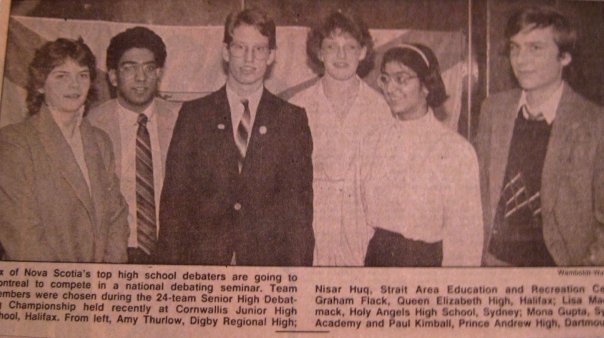
It was a cold, clear night in late December, 1985, just after Christmas, and just before New Year's, and I was out driving around Dartmouth, Nova Scotia, with my oldest pal, Colin White. I was older than my years - when I had showed up that fall to register for my first year at Acadia University, I wore a suit and tie. The senior student who checked me into my residence, who introduced himself to me as "Dude", thought I was having a laugh, until my Mom told him that I was serious. I had never had a drink, and I had never kissed a girl. In the case of the former, I was still underage, my dad was a judge, and I didn't want to do anything that would embarrass him; in the case of the latter, it just hadn't been a priority. I was a Reach for the Top star, a straight-A high honours student, a member of my province's National Debating Championship team... I had "better" things to do.

18th birthday, January 1985

So, sure, I seemed like the "Perfect Kid", at least as far as any kid can be "perfect". But the outward appearance of maturity and responsibility belied a profound inner recklessness, born of arrogance. I chafed at the boundaries that I felt the mediocrity of my peers had placed on me, and like many kids before me, I felt I was indestructible. I hardly ever cracked a book at school, because I didn't have to - it all came so naturally to me. My rebellion wasn't flashy, writ in symbolic gestures that showed nothing more than a desire to conform to another system - any idiot can get their ear pierced. My rebellion was inward, and personal, in little ways that no-one saw, and many that no-one recognized.


For example, when you're on the negative side of a debate, all you really have to do is understand the opponents' position (i.e. their "plan"), and then prepare to argue against it. Pretty simple, and deadly dull. Thus, while everyone else was dancing and chatting each other up at the social events at the 1985 High School National Debating Championships in Montreal, I was sitting at a table writing counter-plans on napkins. What's a "counter-plan", you ask? Well, in short, when the team on the negative side of a proposition put forward a counter-plan, they didn't just argue against the affirmative side's plan - they proposed a plan of their own. In doing so, they also then took the burden of proof. It was definitely the harder thing to do, because it required more prep, and my partners thought I was nuts, and it probably cost me a few rankings points at the end of the day, but it was worth it all just to see the other side squirm when they suddenly saw their entire plan become moot, and they had to wing it. People would ask me why I liked counter-plans, and I never really told them the true reason: I did it because it was the only way that I could stay interested in it all, because it was something different, and because I could.

But I digress...

Not all of my rebellion was quite as... "academic" as constructing debating counter-plans - that just happens to be the one I still recall, and care to recount. It often went a lot further than that, in more dangerous ways. But no matter what I did, I had always emerged unscathed. As I said - I thought I was indestructible, and I was arrogant.

So there I was, on that cold and clear night in late December, 1985, in my Dad's Audi 6000, feeling like the King of the World. I gunned it past the speed limit, and headed for an intersection, and took the turn far too fast, and it was as if time had stopped. It didn't, of course, at least not in the real world, but for me, in that moment, it was like an out-of-body experience. I remember laughing and thinking two things - "cool" and "I can beat this".

And then we went over the hill, and I wasn't laughing anymore.

Time travel back even further...

When I was a kid, around eight, nine and ten, I can distinctly remember lying on the couch at home, on several occasions, reading a book, and then suddenly getting a feeling in the pit of my stomach like I was falling from a great height. I could actually feel the wind rushing around me as the velocity increased... and then it would stop.

It wasn't as if I was falling - it felt like I was really falling.

I've been falling ever since.

But I digress again...

Time travel back to 1985...

We were falling over the edge, and we were definitely going down the small hill, sideways and completely out of control, and I remember seeing the tree coming at my side of the car, and then...

Crash.

My head jerked forward suddenly, just as a large branch of the tree smashed through the driver's side window and pushed itself past where my head had been just a second before.

Time travel forward to 2010...

Lying on the Commons, drunk, in pain, angry... and then it hit me, just as it had hit me almost every day since that crash in 1985.

I should be dead.

Somewhere, if there really are alternate universes, I am dead. Somewhere, that tree caught my temple as it crashed through the window.

But not in this reality.

Ever since has been a retreat from the arrogance of my youth. I'm still reckless, and I'm still selfish, and I'm still arrogant. But less so than I was. I'm not sure I'm a better man, but I like to think so. The one thing I am sure of is that I'm a different one than I would have been otherwise.

Because I should be dead... but I'm not. And that realization has made all the difference in the years since, and will continue to make the difference in the years to come.


I'm living on borrowed time, and I need to make it matter. If you Google my name, you'll find pages and pages about the things I've done since 1985. But if you Google the name "Gil Latter", you'll find one thing at the top of the search - the Gil Latter Memorial Award at Mt. Allison University, given in memory of a best friend of Colin and I who died on his way home one day from Sackville, New Brunswick to Dartmouth in a car accident.

I remember getting the phone call from Colin, telling me what had happened, like it was just yesterday. My first thought was a simple one - "damn it, no." After I hung up, I buried my head in my pillow. I wasn't crying - I still haven't cried. Rather, I just wanted to shut the world out, if only for a few moments, and the pillow was the closest thing I had. As I tried to breathe, another thought crowded its way into my mind - "it could have been me... and maybe it should have been me."


Every fall, I drive over to Gil's grave in Dartmouth with a book, sit down next to it, and read for a while. It's always cold, and dreary, but I never feel cold. I always feel warm, and I never feel like I'm alone.


In the end, I like to think that in the alternate universe, their Gil does the same for me. 

Paul Kimball

Scenes from the Front, Vol. I


"The words of the prophets are written on the subway walls, and tenement halls..."
- Paul Simon

Self-portrait, LA Zoo washroom - California, June 2011.

Paul Kimball

Beauty and the Beast

By any physical standard that our society uses, Natalie Portman is beautiful.


Similarly, by the standards that our society uses, this woman (selected at random from the Internet) is not physically beautiful. If we are to be honest with ourselves, she is not even remotely attractive:


We obviously care about such things. Natalie Portman is a tremendously talented actress, but if she had the same talent but looked like the second woman, would she have the opportunity to pursue an acting career? Unlikely.

But while we care about such things, would an advanced, non-human intelligence care?

What if, for example, such an intelligence was extraterrestrial in nature, and looked like this:


For such a creature, all humans would probably look more or less the same, just as all sperm whales look more or less the same to us.


But we can go even further, and posit that an advanced non-human intelligence is non-corporeal. Perhaps it exists as thought, in a way that we can't imagine (no pun intended)? Perhaps it exists in the physical realm, but not in a way that we can really touch, like a "ball of light".

For such a being, our physical attributes - our conception of what is beautiful, and what is not - wouldn't matter at all.

We would all be "beasts" to them, and if there was a beauty in us for them to find, it would be found elsewhere - in our compassion, perhaps, or our intellect, or our imagination, or our humility.


Until we understand that principle, "contact" will elude us as a society, even as it occurs to those individuals who can see past the superficial notion of beauty that we have created, and find the deeper beauty that exists hidden underneath.

Paul Kimball


A Musical Interlude


In one sense, Simon was right - we are all, in a sense, leaves on the same tree, working our way through the seasons of this life. Part of the whole, as it were - each one interconnected, even if we can't always see it.

But the more interesting part of the song, perhaps, is the bit about the pebble:
I threw a pebble in a brook
And watched the ripples run away
And they never made a sound.
As I watch this video, I can't help but wonder how many of the people in the audience that day have passed away since then. Each of them, in their own way, threw a pebble in the brook. We might never see where the ripples that the pebble makes wind up (or "hear" the sound they make), but they exist nonetheless. No matter how small, they linger on, even after the pebble has sunk beneath the water.

Paul Kimball