Showing posts with label mysticism. Show all posts

Saturday, September 07, 2013

Rev. Kyle Wagner on The Other Side of Truth


My good friend Rev. Kyle Wagner, the Anglican rector for Seaforth Parish in Nova Scotia, joined me this week for a wide-ranging conversation about faith, spirituality, the nature of God and the Kingdom of Heaven, whether or not there is evil in the world, how and why the Church still engages in exorcisms, what happens to us after death… and some paranormal topics as well, including ghosts, the prospect of extraterrestrial life (whether here on Earth as visitors or “out there” among the stars) and how it might affect our view of ourselves and our relationship with God, and Kyle's own personal spiritual awakening.
Kyle has a Bachelor’s Degree in history and political science from Mount Allison University, and a Masters of Divinity from the Atlantic School of Theology. His occasional blog can be found here.
This episode was recorded on 4 September, 2013.
Download this episode directly here, or listen to it at The Other Side of Truth podcast here.
Paul Kimball

Tuesday, August 20, 2013

Mysticism & Me

I got a friendly note earlier this afternoon from a longtime reader who expressed her surprise that I was posting so much about religion and spirituality, particularly mysticism. She noted that it seemed odd for a self-described agnostic to be eschewing rationalism for New Age-ism.

A primer about my background is perhaps in order, in case others are curious, and in case I choose to post more on the topic. The subject of my still not-quite-finished graduate thesis in history was 19th century religion in New Brunswick, in particular the Free Christian Baptist Church as it struggled to reconcile the mystical and experiential roots of its New Light beginnings under Henry Alline in the late 18th century with the 19th century impulse to become more oriented towards the increasingly rationalist mainstream norms of the more established Protestant Churches. This led to a schism within the denomination in the mid 1880s between the majority who had integrated the Church more fully into the broader society, with an emphasis on things like denominational newspapers and bigger and more elaborate churches and paid clergy and missionary societies, and those who wanted to re-focus on the core spiritual experience that they felt was being obscured by non-essentials. They gravitated towards the holiness movement that had been started in the 1840s by the great Christian mystic Phoebe Palmer, who stressed a personal and experiential union with God, and they were eventually expelled from the Free Christian Baptists. They formed their own smaller denomination, called the Reformed Baptists - the Church that my late paternal grandfather, Rev. Hollis Mullen, was ordained in a few decades later.

Portrait of my grandfather Rev. Hollis Kimball,
by my cousin Judy Bouma.

I remember many conversations I had with my grandfather when I was young, and if perhaps I didn't quite grasp everything that he was trying to tell me at the time (I was still just a teenager when he passed away), they were embedded in my memory, and have served as the inspiration ever since for my own truth-seeking. 

So mysticism, particularly of the Christian type, is nothing new to me, both from an academic and from a personal perspective. I remain an agnostic, because unlike my grandfather I have not been able to embrace a certainty about any of it - I've never had that profound encounter with "the divine" that he once described to me, and which changed the course of his life. But I keep looking for it, and trying to understand what it might mean by studying the works and ideas and lives of those who have had it... whatever it is.

Paul Kimball

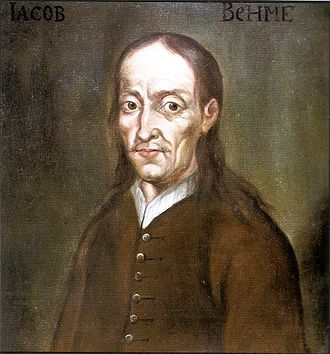
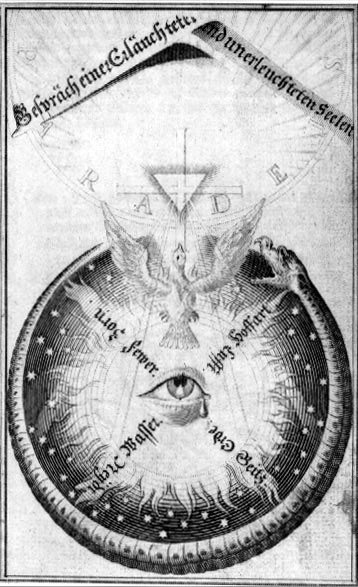
Jacob Böhme and the Nonduality of the Paranormal


Those seeking to understand the true nature of the paranormal would do well to immerse themselves in the writings of the world's great mystics, as opposed to more reports of eyewitness UFO sightings, ghost hunter television programs, or your average once-a-week sermon. A good place to start would be the work of German theologian Jakob Böhme, who lived from 1575 until 1624. He wrote about the non-duality between humanity and God (or, as I would call it, an advanced non-human, or possibly para-human, intelligence). As has been the case for many mystics, in 1600 Böhme had a "vision" that he believed revealed the spiritual structure of the world to him, as well as the relationship between God and man, and good and evil. This was followed in 1610 by another, even more profound experience which convinced Böhme that he had a calling to speak and write about his experiences, and his interpretation of what they meant. He was viewed as a heretic by the Lutheran religious authorities of his time.

Böhme's mystical ideas were complex, and like many of us he struggled within the confines that language imposes on the communication of ideas. But the central thrust of his work,  often presented told in allegorical terms, is clear and accessible, and still resonates today - like the Gnostics, he eschewed the external rule-making god of organized religion, and focused on the search for the Inner Light, "the true light, that lighteth every man that cometh into the world." [John 1:9]

Böhme posited that there was no difference (the "non-duality") between human beings and God - we are part of each other. He wrote:
Don't think that God is only in some far away heaven, and that the soul, when it departs the human body, must soar aloft many hundred thousands of miles off in order to reach Heaven. No, it need not do that to reach Heaven, because when the soul in Christ departs the body, it is already present in Heaven and there the soul is with God and in God, and also with all the holy angels, and the soul can suddenly be above and suddenly beneath; it is not hindered by anything. For in the unity of God there is no separation of seeming distance. Indeed, in what place should the departed soul of man rather be than with its King and Redeemer Jesus Christ? The fact is that near and far off in God are one thing, one comprehensibility; Father, Son, and Holy Spirit, everywhere. 
Moreover, this unity is found throughout the universe, for all that there is both here and throughout the universe is, in essence, one Person manifesting Himself. This seemingly outward universe is nothing more than the Godhead playing the joyous melody of His life through His creative instruments which are all of the varied physical forms found throughout the universe, especially the form known as man which He always intended to be His highest song of praise to His eternal and uncreated glory! So you see that wherever you are in this world, you are in Heaven. 
The universe is the outcome and development of "One Grand Thought." All things are governed by one central law, and all planes of existence are related. "This world," wrote Böhme  "with all of its physical properties is in union with the vast vistas of the heavenly spaces above the earth. There is only one Heart, one Being, one Will, one God, All in all."


Böhme's work is deep and rich, and rewards those who undertake an examination of it with a broader insight of the possibilities inherent in what we call the paranormal, or the supernatural. If we are all one with each other, and the "divine", then the "paranormal" is more than even a reflection of ourselves - it is us, even as it appears separate and often confusing and mysterious, to the point of apparent inscrutability. But that could be the result of our own dislocation from our connection to our true self, which is still there, waiting to be discovered... and perhaps, on a subconscious level, reminding us through lights in the skies and other hints that there is something beyond the rationalist and materialist world in which we have imprisoned our true nature.

A good starting point for internet resources available for Böhme can be found here and here.

Paul Kimball

Into The Mystic


Are we just meat-based computers, or is there much more in there... and out there as well (as George Harrison wrote, within and without you)? That is the fundamental question underlying all aspects of the so-called paranormal, I believe - including UFOs.

The great mystics - which include the Christian mystics - have been wrestling with this topic from the beginning of recorded history. Jesus, for example (the greatest of all Christian mystics, although I suppose that it would be more accurate to view him as a Jewish mystic) - in John 17: 21 - 23 [KJV]:
That they all may be one; as thou, Father, art in me, and I in thee, that they also may be one in us: that the world may believe that thou hast sent me. And the glory which thou gavest me I have given them; that they may be one, even as we are one: I in them, and thou in me, that they may be made perfect in one; and that the world may know that thou hast sent me, and hast loved them, as thou hast loved me.
As I noted in my recent podcast with Dean Radin, this mystical core has been buried by the established churches for most of the last 2,000 years (with the odd exception), but it's still there, open to a much more interesting interpretation and discussion than you'll find coming from most pulpits. And it's in that mysticism that I believe the truth resides, should there be a truth to the paranormal beyond the structures of our rationalist / materialist worldview, because it offers us the opportunity to explore the most fascinating of all possibilities - that at a basic level (call it a quantum level), we are all God, and God is us - in which case, the things we are seeing are things we have created ourselves.

As Hildegarde of Bingen put it: "You are encircled by the arms of the mystery of God."

Or, as Luke wrote [17:21, KJV] - “The kingdom of God is within you”.

Paul Kimball


Monday, June 27, 2011

The Visions of William Blake

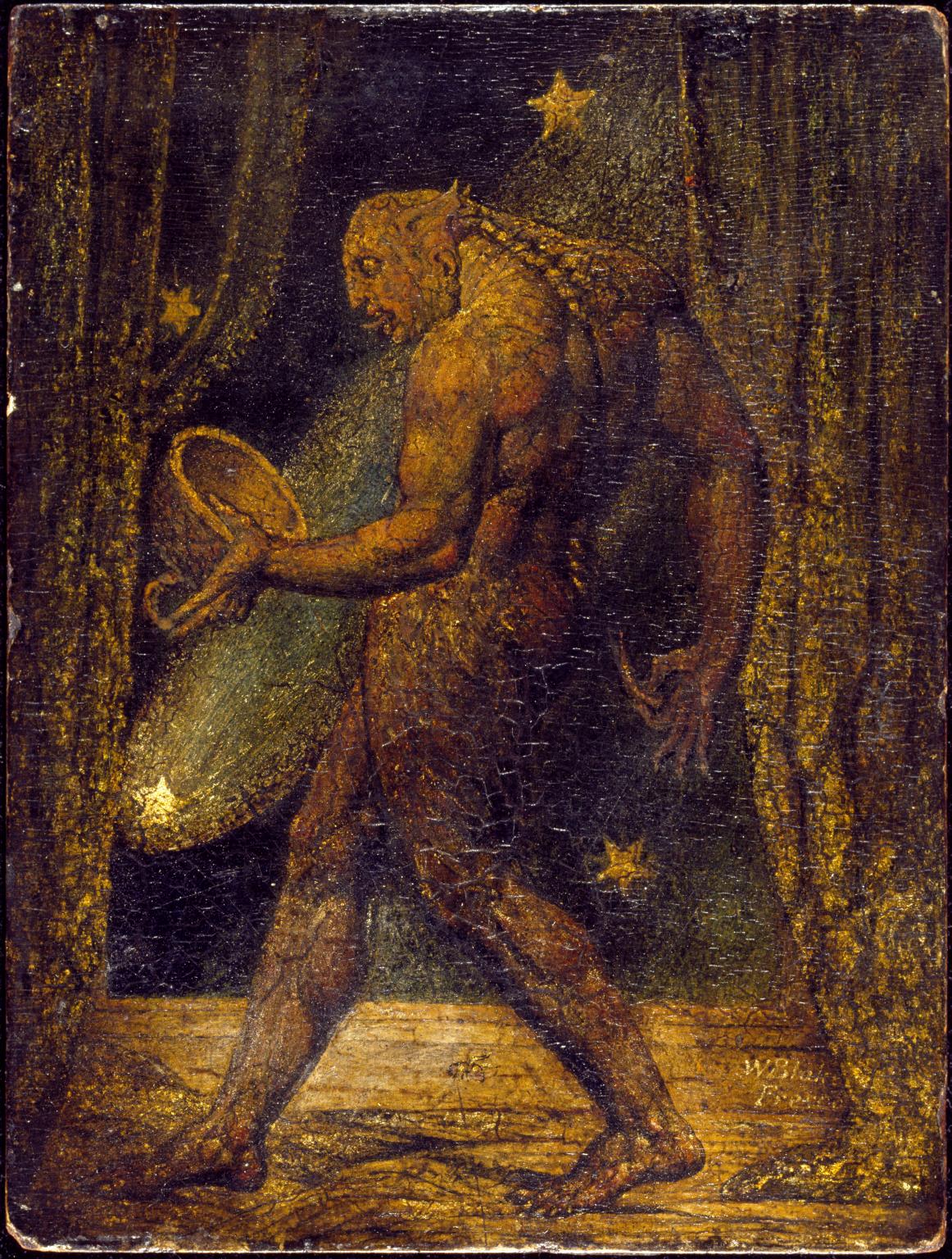
William Blake's "The Ghost of a Flea"
Astrologer and artist John Varley reported that his friend William Blake, who had experienced visions since his childhood, once had a vision of a ghost of a flea at a seance the two held in 1819. According to Varley:

As I was anxious to make the most correct investigation in my power, of the truth of these visions, on hearing of this spiritual apparition of a Flea, I asked him if he could draw for me the resemblance of what he saw: he instantly said, 'I see him now before me.' I therefore gave him paper and a pencil with which he drew the portrait... I felt convinced by his mode of proceeding, that he had a real image before him, for he left off, and began on another part of the paper, to make a separate drawing of the mouth of the Flea, which the spirit having opened, he was prevented from proceeding with the first sketch, till he had closed it.
I highly recommend this New York Times article from 1910 about Blake, his visions and the art that he created as a result. As the Times notes, "Whatever guess we make at the mighty puzzle of this power of vision, one thing is certain. Blake would have been a pale and ineffectual artist without it, and with it he contributed a poignant and enduring force to art."

One can only wonder what kind of diagnosis (and then treatment) a psychiatrist would make today were he confronted with someone like Blake, and the visions that he described. Fortunately, Blake lived in a time well before our modern world of corporatized and commercialized conformity, and was therefore able to use his visions - whatever might have caused them - as the inspiration for his art, his poetry and his philosophy, all work that remains hugely influential to this day.

If there is an "other", advanced non-human intelligence, then I suspect that this is how it communicates with us - through visions. If this is the case, then I believe that we would all have the ability to receive that communication, in some form or another, but that the vast majority of us do not have the willingness to access that ability, largely because we're afraid of what it might represent, namely a loss of control. We want to "fit in" to society as it is structured around us (the ultimate control mechanism), but by fitting in we may be missing out on something far more important, and meaningful - the ability to truly be free.

Paul Kimball