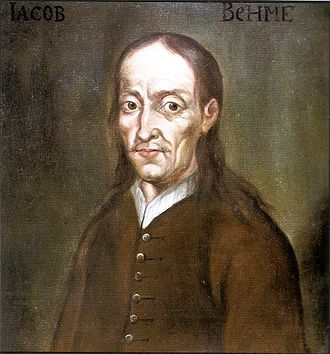
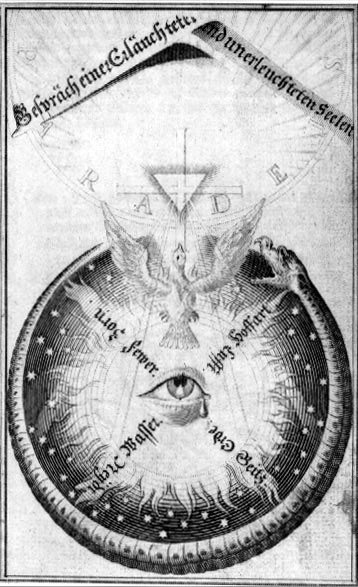
Those seeking to understand the true nature of the paranormal would do well to immerse themselves in the writings of the world's great mystics, as opposed to more reports of eyewitness UFO sightings, ghost hunter television programs, or your average once-a-week sermon. A good place to start would be the work of German theologian Jakob Böhme, who lived from 1575 until 1624. He wrote about the non-duality between humanity and God (or, as I would call it, an advanced non-human, or possibly para-human, intelligence). As has been the case for many mystics, in 1600 Böhme had a "vision" that he believed revealed the spiritual structure of the world to him, as well as the relationship between God and man, and good and evil. This was followed in 1610 by another, even more profound experience which convinced Böhme that he had a calling to speak and write about his experiences, and his interpretation of what they meant. He was viewed as a heretic by the Lutheran religious authorities of his time.
Böhme's mystical ideas were complex, and like many of us he struggled within the confines that language imposes on the communication of ideas. But the central thrust of his work, often presented told in allegorical terms, is clear and accessible, and still resonates today - like the Gnostics, he eschewed the external rule-making god of organized religion, and focused on the search for the Inner Light, "the true light, that lighteth every man that cometh into the world." [John 1:9]
Böhme posited that there was no difference (the "non-duality") between human beings and God - we are part of each other. He wrote:
Don't think that God is only in some far away heaven, and that the soul, when it departs the human body, must soar aloft many hundred thousands of miles off in order to reach Heaven. No, it need not do that to reach Heaven, because when the soul in Christ departs the body, it is already present in Heaven and there the soul is with God and in God, and also with all the holy angels, and the soul can suddenly be above and suddenly beneath; it is not hindered by anything. For in the unity of God there is no separation of seeming distance. Indeed, in what place should the departed soul of man rather be than with its King and Redeemer Jesus Christ? The fact is that near and far off in God are one thing, one comprehensibility; Father, Son, and Holy Spirit, everywhere.
Moreover, this unity is found throughout the universe, for all that there is both here and throughout the universe is, in essence, one Person manifesting Himself. This seemingly outward universe is nothing more than the Godhead playing the joyous melody of His life through His creative instruments which are all of the varied physical forms found throughout the universe, especially the form known as man which He always intended to be His highest song of praise to His eternal and uncreated glory! So you see that wherever you are in this world, you are in Heaven.
The universe is the outcome and development of "One Grand Thought." All things are governed by one central law, and all planes of existence are related. "This world," wrote Böhme "with all of its physical properties is in union with the vast vistas of the heavenly spaces above the earth. There is only one Heart, one Being, one Will, one God, All in all."
Böhme's work is deep and rich, and rewards those who undertake an examination of it with a broader insight of the possibilities inherent in what we call the paranormal, or the supernatural. If we are all one with each other, and the "divine", then the "paranormal" is more than even a reflection of ourselves - it is us, even as it appears separate and often confusing and mysterious, to the point of apparent inscrutability. But that could be the result of our own dislocation from our connection to our true self, which is still there, waiting to be discovered... and perhaps, on a subconscious level, reminding us through lights in the skies and other hints that there is something beyond the rationalist and materialist world in which we have imprisoned our true nature.
A good starting point for internet resources available for Böhme can be found here and here.
Paul Kimball