Friday, June 10, 2005

Blame the Navy?

Rich Reynolds and Chris Jay, over at the RR Group blog (www.rrrgroup.blogspot.com), chastised ufologists today for ignoring the possibility that the US Navy and Army might also have been involved in the UFO phenomenon, and secret projects run under their auspices may have been responsible for some (all?) UFO sightings, particularly in the early days of the phenomenon.

Ignoring for the moment that all ufologists - a diverse group if ever there was one - are lumped into one pile by Rich and Chris (many ufologists, I suspect, could care less about Roswell, or the history of the phenomenon), their contention is flat out wrong. Ufologists have not, as Rich and Chris suggest, restricted their attention to the efforts of the Air Force with respect to UFOs, including as a possible explanation for sightings. Neither has the media.

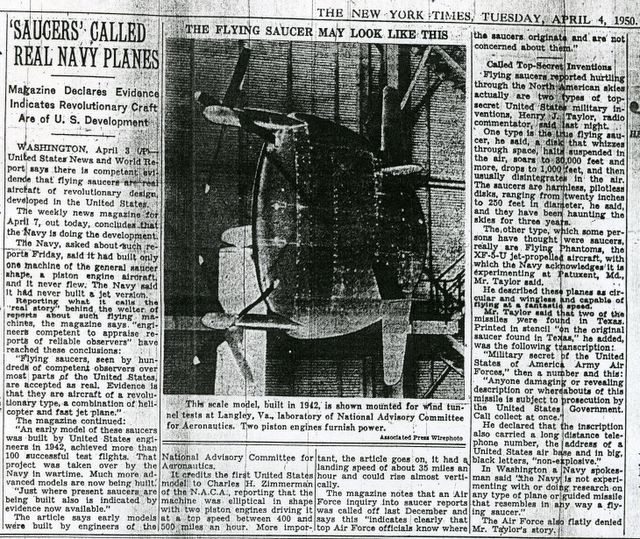
For example, this article from the New York Times, 4 April 1950, puts forward the notion (first reported in US News and World Report) that UFOs (or "flying saucers" as they were called then) were the result of top secret Navy research and development programs, some stemming back as far as 1942.


So, was it the United States Navy?

Who knows?

If it was, however, someone seems to have forgotten to tell Secretary of the Navy Dan Kimball, and Admiral Arthur Radford, who had their own, still unexplained, sighting in 1952 while flying - in separate planes - over the Pacific Ocean (on their way to Hawaii). They were both at a loss to explain what they saw, and certainly didn't write it off as "just another one of our experimental craft."

Still, my point isn't that the Navy shouldn't be looked at as a source of possible explanations for UFO sightings / reports of crashed saucers, but rather that ufology has been well aware of the Navy's potential role for decades now, even as they have been unable to pin it down. If Rich and Chris have something to offer with respect to the latter, then good for them, and I look forward to reading it when they make it available.

Who knows - it may actually be something that no-one has ever seen before (in which case I'll be the first to applaud)?

But I think they would be better served making their case, and not using the Navy angle as a cover to take another gratuitous shot at ufologists, and, by extension, ufology. There's plenty of legitimate reasons to question ufology, without accusing it of a dereliction that is simply not the case.

Paul Kimball

Thursday, June 09, 2005

Project Y-2 becomes Project Silverbug

Project Y-2 became known in the United States as Project Silverbug. Pictured below is one of the technical schematics.


For further information see http://www.project1947.com/fig/sb/silverbu.htm, where you'll find all sorts of fascinating photos, tech specs, and illustrations.

Paul Kimball

Canada & Flying Saucers, Part I

When ufologists talk about the history of the UFO phenomenon in Canada, they usually focus on Wilbert Smith (I'll have more to say on him in the days to come). In doing so, they miss or underplay the real story. Here is an exchange from a session of the House of Commons Question Period from 1955, as recorded in the Canadian House of Commons Debates, Official Report (Vol. II, 1955).

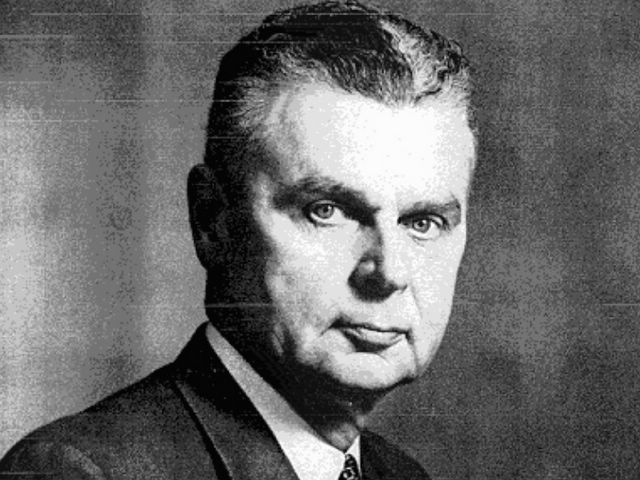
The man asking the questions is the Hon. John Diefenbaker (below), who would, two years later, become Prime Minister of Canada (his tenure, from 1957 to 1963, was one of the most controversial in Canadian history, much of the controversy stemming from Diefenbaker's relationship with the United States - for more on "The Chief" see: http://www.nationmaster.com/encyclopedia/John-George-Diefenbaker).


"Topic: Defence Production

Mr: Diefenbaker [Note: The Progressive Conservative M.P., Prince Albert]

1. Has the Department of Defence Production attempted to have a flying saucer built?

2. If so, has the attempt been abandoned?

3. What has been the total expenditure incurred to date?

Mr. Dickey [Note: Hon. J. H. Dickey, Parliamentary Assistant to the Minister of Defence Production]

1. In 1954 the A. V. Roe Company was given a contract to investigate the possibilities of a vertical take-off aircraft. No authorization was given for construction of a prototype.

2. Canadian government support for the project has been withdrawn.

3. $396,740.09 - Subject to final audit by cost inspection and audit division, comptroller of the treasury."

Almost $400,000, at a time when $400,000 was a LOT of money! Compare that to Wilbert Smith's part-time, penny-ante Project Magnet, or his "UFO detection" station at Shirley's Bay, and ask yourself where the real "flying saucer" research was being done in Canada, by whom, and to what end (hint: it wasn't to see if aliens were coming here; it was to develop advanced weapons systems).

So, what happened to the research (known as Project Y2, classified Secret)?

We turned it over to the Americans (to be precise, the Air Force). For more information, see Redfern, Nick and Andy Roberts, Strange Secrets: Real Government Files on the Unknown (New York: Paraview Pocket Books, 2003), pp. 86 - 98, or Nick's most recent article in Phenomena at:

www.phenomenamagazine.com

Incidentally, this was not the last time that John Diefenbaker and A. V. Roe were linked. It was his administration that pulled the plug on the AVRO Arrow fighter jet project, a plane that was superior to anything the United States or the USSR had at the time. They destroyed the prototypes, and many of the Canadian scientists and researchers who worked on the project wound up working in the United States, including NASA.

See: http://archives.cbc.ca/IDD-1-75-275/science_technology/avro_arrow/

Paul Kimball

More on Gen. Smith & the 1 August 1950 meeting with Truman

The article shown below is from the August 28, 1950 edition of Time Magazine.


Again, the fact that General Smith was in the news in August, 1950, due to his nomination as CIA Director, should not have come as any surprise to the MJ-12 proponents.

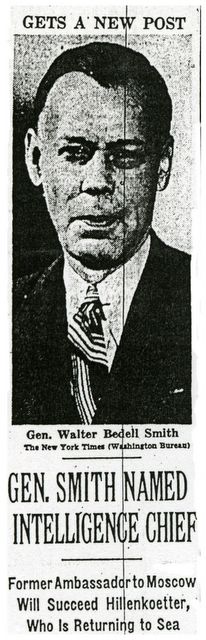
That Smith was publicly being mooted for the DCI job was well known as early as May, 1950. The NY Times, for example, reported on 30 May, 1950, at p. 5, in an article titled "High U.S. Post Due for Bedell Smith: Commander of First Army Likely to be Named Director fo Central Intelligence," that "Lieut. Gen. Walter Bedell Smith... is likely to be appointed Director of the Central Intelligence Agency, according to authoritative reports here today... Authoritative sources said, however, that President Truman has not yet made up his mind on General Smith, principally because of the general's health. He left Walter Reed Hospital after a major abdominal operation May 22 and has returned to First Army Headquarters at Governor's Island, New York, for convalescence."

By 1 August, 1950, he was ready to accept the DCI post, which is why Truman met with him. As Newsweek noted on 28 August, 1950, "Before the President named Smith he took one precaution: he made sure that the General's ulcers were on the mend." This was undoubtedly the reason for the 15 minute meeting on 1 August 1950 between Truman and Smith - to confirm that Smith would take the job, and that he was healthy enough to do so.

No big mystery, no great conspiracy - then or now.

Paul Kimball

Wednesday, June 08, 2005

Correction Re: Friedman, MJ-12 and FUFOR grant

Note:

In the post "MJ-12 - R.I.P." I referred to a FUFOR grant that Stan Friedman received for research to determine the authenticity of the MJ-12 documents in the amount of $32,000.

The actual amount was $16,000, composed of $8,000 raised by FUFOR and another $8,000 from a source that matched the FUFOR money.

As Stan notes:

"Paul: My grant was 16K. That was the amount I asked for in my proposal. Half of my 16K grant was from matching funds provided by the prince. I thought you might not have understood and thought the 16K was matched by another 16 K from somebody else. Not so.
Stan"

That is indeed what happened. Sorry for the confusion - while the original post has been amended, I felt it was important to make the point in a separate post as well.

Always happy to acknowledge errors!

Paul Kimball

Vannevar Bush & the Will to Believe

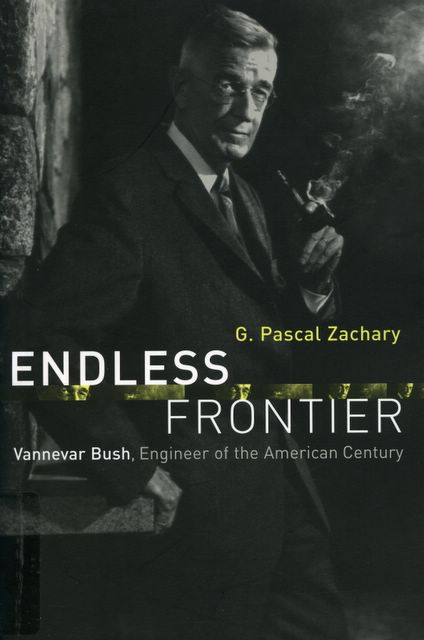
My copy of Endless Frontier: Vannevar Bush, Engineer of the American Century, Pascal Zachary's excellent biography of Dr. Vannevar Bush. It is a must read for anyone who wants to discuss Bush's supposed involvement with UFO's in the late 1940s and early 1950s (whether in relation to MJ-12, or the Wilbert Smith memo).


One of the best, and most relevant, passages can be found at pp. 345 to 347, describing Bush's departure from the Research and Development Board, and public service in general.

"Though Bush kept tight-lipped about his personal situation, journalists sensed that his departure signaled the end of an era in military research and in science policy generally. In the years since the war he had gained a growing reputation for conservatism and for a penchant for shooting down the high-tech dreams of military enthusiasts. Bush would never again formally advise any president or cabinet secretary. Bolder, younger research leaders were now consulted. These successors walked in Bush's footsteps to a degree, and many actually trained under him. 'There is hardly a field in the government's scientific front, from the Atomic Energy Commission down, where a Bush-trained man is not taking a prominent part,' wrote one journalist. 'The same is true of many scientific research efforts in universities and private industry.'

The nation paid its respects to Bush's contribution. 'President Truman spoke for the whole country when he paid warm tribute to Dr. Vannevar Bush,' The Cincinnati Post wrote. The New York Times added, 'The President was right in saying that his regret [at Bush's departure] will be shared by scientists and higher miltary officers.' The Kansas City Star celebrated the man 'who has been chief of staff for the technological side of our defense efforts since 1940.'

The press was respectful, even reverential toward Bush as they were to nearly all American leaders at the time. No newspaper or magazine supplied even a hint that Bush left government a broken spirit, bereft of influence, repudiated by military leaders whom he wished more than anything else to stand among. Indeed, just a few months before his health failed, one national magazine enthusiastically profiled Bush, calling him 'chief of U.S. brain power' and 'one of the most important men in America.'

The image of Bush as a tragic hero, cut down by his refusal to bend to the military's will, was not a story the press could either comprehend or nicely package. The sharp decline in Bush's clout among scientists and the Washington establishment, hinted at two years before by Fortune, simply did not square with the durable celebrity awarded heroes of World War II. Paradoxically, Bush was more celebrated now, when he lived on the margins of power, than he had been in 1944, the high-water mark of his influence on government. Few charted Bush's rapid descent. Only his circle of close associates - men such as Warren Weaver, Jewett, Conant and Compton - realized that Bush's audacious campaign to bring government under the full sway of experts had come to an end.

Bush's defeat and expulsion from power were predictable from one standpoint. It was not just Truman's aloofness from Bush that cost him his clout. Neither did the National Security Act of 1947, despite giving too much autonomy to the services and too little to department officials, doom Bush. His problem was personal. 'There isn't much middle ground about the way people react to Bush,' a journalist wrote in mid-1948. 'Either you think he's wonderful... or you hate him violently.' For a time, Bush's friends counted more than his foes. Then the tables turned. He had stoked the military's resentments during the war, and these resentments came home to roost. Too many military men and civilian scientists disliked him, if not for what he stood for then for his sometimes-imperious manner. Whereas other civilians, such as Edward Bowles, adapted to the military's existing institutional arrangements, Bush demanded 'coequal' status for civilians and a level of interservice cooperation that seemed unthinkable to the top brass. Neither could be achieved without a revolution in civil-military relations. During a deepening Cold War, this was not about to happen. Both soldiers and civilians were too stressed by immediate demands to overhaul the military's structure."

It should be obvious that the MJ-12 proponents, like Wilbert Smith fifty years earlier, simply accepted the public image of Bush that Zachary notes still existed in the late 1940s.

For Smith, this is understandable, as he was fed disinformation in 1950, at a time when the truth was still largely private - and certainly would have been unknown to a mid-level Canadian civil servant like he was.

But the MJ-12 proponents, and those modern ufologists who still treat the Smith memo as gospel, have had the truth placed in front of them for years now, from a variety of different sources, and yet still continue to ignore it.

Is their "will to believe" really that strong?

So it seems.

Paul Kimball

Tuesday, June 07, 2005

General Smith in August 1950 - No Big Secret

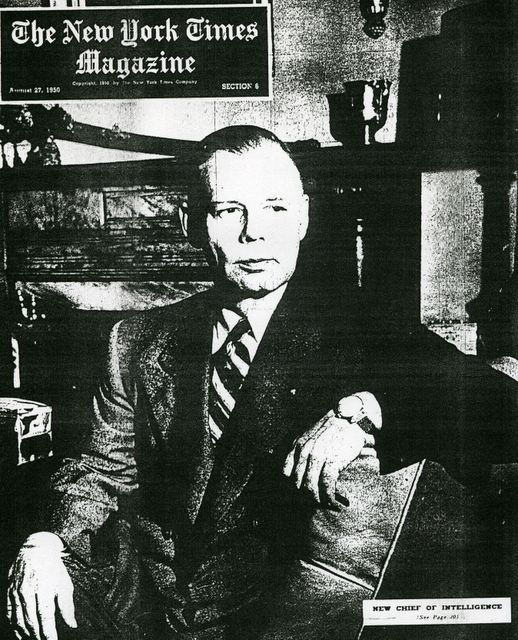
The cover of the New York Times Magazine from 27 August, 1950. There was a full page article on p. 30.


No big secret.

Paul Kimball

The Real Reason Gen. Smith Met Truman on 1 August 1950

In Top Secret / Majic, Stan Friedman writes that, when he saw the August 1, 1950 date for the supposed appointment of Walter B. Smith as a permanent member of MJ-12, it was "difficult to imagine what was special about it." He did some research, and discovered that it was the first time that Smith had met with Truman in eight months, that it was off the record, in an area where they were unlikely to be seen, and with no press present.

To Stan, this was confirmation of the 1 August 1950 date given in the EBD when Smith was supposedly appointed the permanent replacement for James Forrestal on the alleged MJ-12 group. After all - what else could it have been for?

Er...

A quick look at the newspapers of August 1950 tells us that the meeting was undoubtedly held to confirm that Smith would accept the post of CIA Director.

On 18 August, 1950, the White House released this information to the public. For example, here is a portion of the front page article from the 19 August 1950 New York Times (below)announcing that Smith had agreed to accept the post. The next week contained further articles and editorials in the Times about Smith's appointment, including a cover article in the New York Times Magazine on 27 August 1950, and coverage of his confirmation hearing in the Senate, which went off without a hitch later that month.


Indeed, as the Times article on the 19th makes clear, Smith's appointment had been rumoured since at least late May. However, Smith had been very ill in the Spring and early summer, which explains why he wasn't appointed earlier, and why he had not met with Truman in the preceding months. The article also noted that Rear Admiral R. H. Hillenkoetter, the DCI Smith replaced, had been asking "for months" to be relieved of the post and returned to sea duty. Truman clearly waited for Smith to recover from his health problems (as he had by 1 August 1950), and then made the move.

Stan makes much of the fact that the meeting on the 1st of August was secret - well, of course it was! All Presidents seek to control the release of information from the White House, particularly on a matter as sensitive as the nomination of a new DCI at a time when the CIA was under intense Congressional scrutiny for perceived intelligence failures in the months leading up to North Korea's surprise attack on South Korea. Indeed, Hillenkoetter had been called before the Senate Appropriations Committee within a few hours of the attack, and had been getting hammered, to the point of being a lame duck, ever since.

Anyone forging the MJ-12 documents could have easily accessed this information from their local library, just as I did. Smith had already been identified publicly by Stan and others as a logical choice to be on any committee dealing with a crashed flying saucer (see Top Secret / Majic, pp. 24 - 25). All a hoaxer had to do was to check the papers to find the proper time frame. Then, if that hoaxer had access to government records (like, say, an AFOSI agent would), it would have been easy to pin down the 1 August 1950 date, and insert it in the Eisenhower Briefing Document.

Despite what Stan has suggested, there was never any big mystery here. It is clear that this brief meeting had nothing to do with crashed flying saucers, and everything to do with the extremely important matter of Smith's nomination as DCI.

Paul Kimball

Monday, June 06, 2005

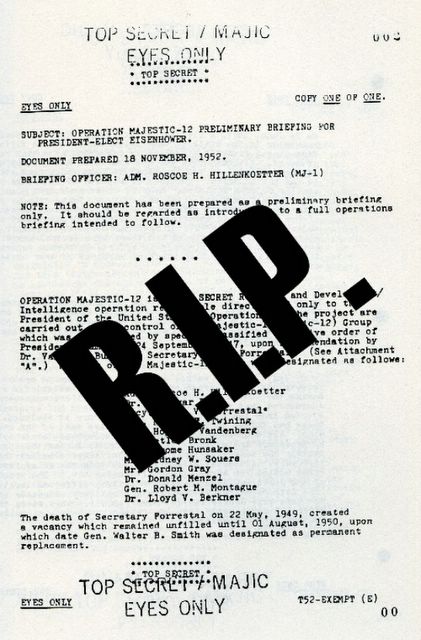
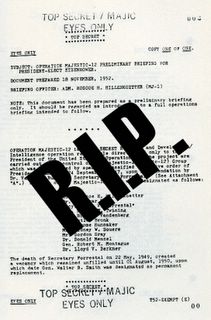
Majestic 12 - R.I.P.


Back on March 10th I posed four critical questions for the remaining MJ-12 advocates, Stan Friedman in particular, to answer. They can be found at www.redstarfilms.blogspot.com/2005/03/my-mj-12-mea-culpa.html. A failure to do so, I indicated, would serve as confirmation that the MJ-12 proponents, despite their many proclamations to have proved the original documents genuine, had done nothing of the sort (note - when I refer to the "original documents" I mean the Eisenhower Briefing Document, Truman-Forrestal Memo, and the Cutler-Twining Memo). Indeed, I am convinced that a failure to answer any one of these four questions is, in and of itself, sufficient to prove the opposite - that the MJ-12 documents are not genuine.

In his most recent MUFON Journal column (May, 2005), Stan has presented his "answers" to these questions.

I admire his tenacity, just as I have always admired Stan (and still do). Anyone who doubts that should look at my film Stanton T. Friedman is Real. That said, however, Stan's "answers" are no answers at all. Rather, they are a mixture of very selective evidence, double-standards, faulty conclusions, and wishful thinking. Unfortunately, this is all that the MJ-12 defenders have left.

So, here is my response to Stan's article. I quote in full from Stan's responses in the MUFON Journal, I reference my four original questions, and then I provide my rebuttal to Stan's points(in some cases, also referring to previously published posts here at The Other Side of Truth).

Question #1

Original Question: Why has no in-depth investigation been conducted by MJ-12 proponents into the second alleged crash referred to in the EBD, the El Indio - Guerrero incident? In fact, why is that alleged incident not discussed - at all - by Stan Friedman in either his paper "Final Report on Operation Majestic 12" or his later book Top Secret / Majic?

Stan's Response: "Paul asked why I had not investigated the crash noted on page 5 of the EBD on 06 December, 1950, in the El Indio-Guerrero area of the Texas - Mexican border. The reasons are simple: I live a long way from there and had nothing to work with, neither names of people nor a specific location. The EBD says "what remained of the object had been almost totally incinerated. Such material as could be recovered was transported to the A.E.C. facility at Sandia, New Mexico." I have been to Sandia. The chance of getting any information from this high security nuclear weapons lab would be nil. Furthermore, I was well aware that some investigation was being done by two Texans, Dennis Stacey and Tom Deuley, of MUFON. They had some leads which didn't pan out. I do note that there had been a National Red alert called on that date because of something flying towards the Southwest as noted by Dr. Bruce Maccabee in his book about The FBI and UFOs. I had my hands full with my Roswell Investigations, where there was a lot to work with."

My Rebuttal: Simply put, Stan has not explained the inclusion of this supposed incident in the MJ-12 documents, when there is no evidence that it ever happened (read carefully – he presents none). His answer is no answer at all. This is a glaring error in the EBD which Stan, because he cannot explain it, chooses to ignore. Stan had plenty of time (and money, thanks to a $16,000 FUFOR grant) to check up on Donald Menzel’s “secret life” – one would think that he would have checked into such an obvious problem with the MJ-12 documents as El Indio.

Further, his contention that the research by Stacey and Deuley "didn't pan out" is simply false. The conclusions that they reached are not ones that Stan, as an MJ-12 proponent, wants to hear, but they exist nonetheless. Their initial conclusions can be found at:
http://www.teenja.com/p/articles/mi_m1430/is_n6_v17/ai_16595647?pi=tnj. This was followed by a presentation at the 1999 NUFOC Conference which solidified their case.

Stan also likes to ignore the fact that the entire El Indio story comes to ufology from discredited researcher Todd Zechel. Karl Pflock tells an interesting story about a conversation he had with Stan a couple of years ago (which mirrors some that I've had with Stan on this subject):

"In the course of [our] conversation, MJ-12 came up (surprise!), and I mentioned the second saucer crash referred to in the MJ-12 Eisenhower Briefing Document: 'On 06 December, 1950, a second object, probably of similar origin, impacted the earth...in the El Indio - Guerrero area of the Texas - Mexican boder (sic)...' I asked Stan how he could continue to argue for the authenticity of the EBD and the reality of MJ-12 with this little clinker in the mix. Puzzled, Stan asked what I meant. I reminded him that this alleged event was introduced to saucerdom by the long-since discredited W. Todd Zechel. I reviewed the years-long investigation by top MUFON official Tom Deuley and Dennis Stacy that had established the tale was the product of fragmentary recollections of a real event (the accidental shootdown of a Civil Air Patrol plane) and Zechel's fevered imagination and ambition, about which both Tom and Dennis had written and publicly spoken. 'El Indio?...', Stan said. 'Well, I...' Then, with a worried look, he changed the subject. It was as if he'd completely forgotten that the Texas-Mexico 'boder' incident was mentioned in his favorite Cosmic Watergate evidence. I had the distinct impression that Stan had been so wrapped up for so long in touting Menzel's 'secret life' and debating date formats, presidential signatures, and classification markings that he'd completely neglected this little red flag flapping in the ufological breeze. Well, Stan??"

Karl raised these questions in the May 2002 issue of Saucer Smear, which Stan receives, and to which he often writes in response to something he has read there. Stan offered no response this time, however. See http://www.martiansgohome.com/smear/v49/ss020505.htm

Finally, note that Stan only responded to half of my question, about the investigation of the alleged El Indio incident. Apropos of Karl's comments above, Stan avoided answering my question as to why he did not mention the alleged El Indio crash in either his MJ-12 report or his MJ-12 book. The answer, to me, is obvious - he does not address it because, at the very least, it casts doubt on the authenticity of documents which he maintains are "Real!"

Question #2

Original Question: Why is no mention made of the rapid decline of Vannevar Bush's role in government after World War II, and the unlikelihood that he would have been appointed to such a super secret project as MJ-12 by President Truman?

Stan's Response: [Note: Stan's response in the article is blended with a defence of Wilbert Smith, which I'll deal with in a later post as a separate topic. I will exclude the Smith material here, except as it may be relevant to the question about Bush, above]. "According to the Truman-Forrestal memo of Sept. 24, 1947, Truman authorized Forrestal (not Bush) to proceed with operation Majestic 12, but did say, 'It continues to be my feeling that any future considerations relative to the ultimate disposition of this matter should rest solely with the Office of the President following appropriate discussions with yourself, Dr. Bush, and the Director of Central Intelligence...

On Sept. 24, 1947, Bush had been named head of the US Research and Development Board, a successor to the Joint Research and Development Board, which had succeeded the OSRD. This was the date of the infamous Truman-Forrestal memo establishing MJ-12, and the only date in a period of several months when Bush, Truman, and Secretary Forrestal were all together at the White House. Obviously Truman did NOT appoint Bush to head MJ-12. Truman said to Forrestal, 'You are hereby authorized...'

Furthermore, in Bush's notes on the meeting we find this statement: '... certainly in the new post, I would be rather frequently in contact and that if there was an impression [in the scientific community] that I did not have his confidence he felt that impression would soon be corrected by future relations.' If Truman had no faith in Bush, why would he have named him head of the R & DB? His MJ-12 activities would be in total secrecy and not a matter for public debate.

In a TOP SECRET memo of 16 December, 1947, Forrestal's special assistant, John Ohly, sent a memo to Bush noting that he had been appointed by The War Council as chairman of a special committee to deal with 'Preparations against a sneak attack,' and loads of resources were available to him. (No indication fo whether this attack would be from RUssia or aliens or...) General Hoyt Vandenberg, also an MJ-12 member and USAF Chief of Staff, was a member of this committee. TOP SECRET minutes of a later War Council meeting note that all members had received a copy of a TOP SECRET item from Bush, and should be prepared to discuss it. There is no clue as to what it was about.

This committee and MJ-12 were not public groups wherein political considerations might have been very important, but were highly classified Black Budget groups. It seems to me that Bush's advice and knowledge would have been sought because of his long history of massive contribution to the military effort via his earlier chairmanship of the NACA, the OSRD and JRDB. Nobody was more knowledgeable concerning who had what capabilities at what installation for top-notch, highly-classified research - such as trying to determine the Modus Operandi of flying saucers.

Truman certainly had strong views about how research grants might be distributed, etc, and zealously guarded control. Bush had been allowed much leeway under Roosevelt. A book strongly contributing to Paul's feelings about Bush vs. Truman is G. Pascal Zachary's Endless Frontier: Vannevar Bush, Engineer of the American Century (The Free Press, 1997). I note with dismay that Vandenberg and War Council are not even listed in the index. I had a conversation with Zachary, a Wall Street Journal reporter, years ago, and at that time felt he was not very familiar with Bush's classified activties."

My Rebuttal: There are so many distortions, deliberate exclusions of critical evidence (I say deliberate because I know Stan is aware of this evidence, having brought it to his attention myself), and red herrings, in Stan's response, that it is difficult to know where to begin.

Perhaps the first thing I should do is refer the reader to my previous posts on Bush (which, again, I know Stan has read, because we have discussed them). Read them first, and then return here - they can be found at:

http://redstarfilms.blogspot.com/2005/03/end-of-frontier-vannevar-bush-harry-s.html

http://redstarfilms.blogspot.com/2005/03/oh-canada-wilbert-smith-ufos.html

Welcome back!

Now, if you've read those two posts, you'll notice a few key things about Stan's response.

First, he mentions the 24 September 1947 meeting, and provides a portion of a quote from Bush's memo of that meeting which seems to indicate that Truman had expressed his complete confidence in him. This is selective evidence at its worst, folks. Stan implies that Bush was at this meeting to talk about MJ-12; nothing is further from the truth. Bush makes it clear that he was at the meeting to discuss taking the RDB position (which, as Zachary pointed out, was NOT the job that Bush had wanted - he wanted Secretary of Defence). Bush expressed his willingness to take the RDB position for a year or so, but only on one condition - the scientists in the country had to feel that he had the confidence of the President. According to Bush, Truman replied that he did not see how they could think otherwise, and that "Bush certainly had his confidence." This was not enough for Bush, however, who knew better. He told Truman, in a section of the memo that Stan conveniently omits (because it shows the true nature of their relationship), that "inasmuch as he had not called me in for anything for a year, and since the last report was made on the future of science in this country was made by someone else, scientists naturally gathered that I was not in his confidence." [Emphasis added - PK]

It is only after this extraordinary SECOND request for a vote of confidence that Truman utters the statement that Stan DOES quote.

Stan also fails to mention some other key facts. Most important, Stan OMITS, even though he is well aware of it, that in 1950 Bush met with William Golden, Truman's science policy adviser, and bemoaned how out of the loop he was. In a memo of the meeting, Golden wrote, "Bush is now on the outside so far as Government scientific matters are concerned, a position of which he is very conscious and to which he referred time and time again." [Emphasis added just so there can be no further, er, confusion]

Stan also FAILS to mention that none of this was news to Bush, who discovered early on that his relationship with Truman would be much different than the one he had enjoyed with Roosevelt. In a 15 minute meeting on 14 June, 1945, Bush met with Truman, who told Bush that he "liked" Bush's "Endless Frontier" report, which was of fundamental importance to Bush, who saw it as providing the blueprint for the future of science in the United States (a future that would have Bush at the helm). It was eerily similar to Truman's forced expression of confidence at the September 24, 1947 meeting with Bush about the RDB post. Bush left the 1945 meeting feeling good about his prospects. Later that day, a presidential aide told him that Truman had rejected "Endless Frontier." Not the president, even though he had met with Bush earlier that day about that very subject - but an aide!

As I state in my blog The End of the Frontier: Vannevar Bush & Harry S. Truman (see link above), this snub was "indicative of what Truman really thought of Vannevar Bush, a man who, as he got the news, must have realised that he had reached the beginning of the end of his own, once seemingly endless, frontier in government service."

Stan mentions that Pascal Zachary's biography of Bush, Endless Frontier: Vannevar Bush, Engineer of the American Century (New York: The Free Press, 1997), strongly contributed to my "feelings" about the nature of the relationship between Bush and Truman. While it is true that I utilised Zachary's book in reaching my "conclusions," I conducted other independent research as well (such as the Golden memo, noted above).

Stan also brushes aside Zachary's knowledge of Bush's classified activities, and, in doing so, seeks to undermine Zachary's book as a valuable source of information. Unfortunately for Stan, he's flat out wrong about this. The Zachary book is extensively footnoted and referenced, and those notes and references indicate that Zachary was well aware of Bush's classified work. With respect, Zachary, who spent TEN YEARS researching the book, has done far more research into Bush's life and work than Stan has, and crafted the definitive biography of Bush.

Don't take my word for it, however. Look to the reviews. For example, The New Scientist called the book a "fascinating biography [that] will probably become the standard work on Bush." The New York Times Book Review called it "deeply informed and insightful," and stated that "Zachary has thoroughly captured the spirit of Bush and his times." The MIT Press called it a "balanced and gracefully written biography," and assessment echoed by www.salon.com, which found it "eloquent." Richard Herman, in a review vetted by Erich Bloch, former director of the National Science Foundation, wrote "Zachary has written a compelling and well-researched chronicle of the career of Vannevar Bush... [that] describes in (sometimes painful) detail not just Bush's successes but his failures as well - if you will, his rise to and descent from power." Cliff Barney in Upside wrote, "This book provides a framework for understanding the incredible changes wrought in U.S. Society by the power and influence of govenment-backed scientific technological research... This is an important book... Zachary tells [Bush's] story with stylistic grace and attention to detail." The Library Journal wrote "Zachary uses extensive detail to create an apotheosis of a hero who brought modern science and the centralized organization to bear on winning the war and establishing the modern public-private partnership. With over 70 pages of end notes, bibliography, abbreviations and index; recommended for academic and large public libraries." Finally, Kirkus Reviews wrote "Disproving Vannevar Bush's claim that any biography of him would be terrible, Zachary deftly follows the life and career of the single most important scientist working for the U.S, during WW II. Zachary relies heavily on Bush's writings as well as on interviews with coworkers and family to construct a portrait of the genius who helped create the military-industrial complex when he served as director of the Office of Scientific Research and Development during the war." [Emphasis added]

How many of those writings did Stan read, exactly? How many co-workers and family members did he interview, exactly?

Stan doesn't like Zachary's book because it presents an accurate picture of the Bush -Truman relationship (as Bush's own writings, and Golden's memo, cited above, confirm), and therefore blows a huge hole in his MJ-12 theory.

That is "research by proclamation."

Now - about those red herrings.

The biggest one is the War Council memo to which Stan attaches such importance (in a classic case of missing the forest while looking at a tree).

Stan is correct about one thing - it was Top Secret (which should come as no surprise). After that... well, read on.

The fact that Bush, who was the head of the RDB at the time, would be appointed to a committee of the War Council should not come as a surprise. The RDB was put in place, after all, for the specific purpose of providing advice to groups like the War Council. Further, it was not Truman who appointed him to this committee (indeed, Truman may not even have been aware that Bush was on it), so this tells us nothing about the nature of his relationship with Truman.

Stan also overstates the importance of the memo. For example, he writes that "loads of resources were available" to the committee, as if this was a major, special undertaking. However, as the memo makes clear, there was nothing exceptional about this. As Ohly wrote, "As in the case of all committees of the War Council, your committee will be authorized to call on all agencies under the Secretary of Defense for such assistance as the committee may from time to time require." [Emphasis added]

Also, Stan fails to note that, although the committee was given the broad topic of preparation for a sneak attack, it was struck to deal "particularly" with the question of civil defense in case of a sneak attack (one wonders if this committee is the one that came up with the "bright" idea that students should "duck and cover" under their desks in case of nuclear attack?). Further, Stan implies -in what is perhaps the most wild-eyed piece of speculation I have ever heard from a serious UFO researcher - that the "sneak attack" may have referred to an extraterrestrial threat! Of course, there is NO evidence to support this speculation, which, I suspect, is either designed to draw attention from the real issue here, making it another huge red herring, or evidence that Stan has gone way overboard on the whole "Cosmic Watergate" thing.

The mention of John Ohly did get me thinking, however - surely if Bush was such a Big Shot in 1947 and 1948, he would feature prominently in any oral histories given by people who would have been in a position to know at that time? So I checked at the Truman Library website (www.trumanlibrary.org/oralhist) where they maintain a very large on-line selection of oral history interviews conducted over the years with various members of the Truman administration (it's a great place to go if you want to see examples of how oral research should be conducted). I read through the oral histories given by three key advisers to Secretary of Defence James Forrestal -Ohly, who was Special Assistant to the Secretary of Defense from 1947 to 1949; Wilfrid McNeil, another Special Assistant to the Secretary of Defense; and Max Leva, General Counsel to the Secretary of Defense from 1947 to 1949 (he also served as Assistant Secretary of Defense from 1949 to 1951). None of them mention Vannevar Bush.

This makes sense, because at the time the RDB, despite what Stan would have you believe, was relatively small potatos, and a mess. Dr. James Conant, for example, told William Golden in December 1950 that while Bush was an "industrious person," he had "failed to make much of a go of it [the RDB]." This is an understatement, as even a cursory read through Zachary's book, for example, makes clear.

Stan also ignores the clear evidence that can be obtained from Bush's obituaries that his star had waned by 1947. Take, for example, the New York Times obituary for Bush (30 June, 1974, pp. 1 and 36), which devoted six columns to his life, but only two short paragraphs to his work after World War II. Similarly, Physics Today (September 1974, pp. 71 - 72) observed, correctly, that Bush would be "chiefly remembered for his leadership of the Office of Scientific Research and Development during World War II" and the twenty years prior to 1938, when he "attained great distinction as a professor of electrical engineering at MIT." Not his work after the war, which was not mentioned.

There is also the matter of Bush's opposition to guided missiles and, later, the space program. I asked veteran UFO researcher Brad Sparks about this (he knows more about it than I do). Like me, Brad is a friend of Stan's. His response?

"This reminds me very much of Stan’s selective omission about my early arguments against Bush ever being selected to head a Top Secret investigation of space visitation when he was such an outspoken enemy of rocketry and space travel. He was responsible for helping kill the first ICBM program with his scornful US Senate testimony on Dec 5, 1945, and his opposition to rockets and space travel continued for the rest of his life. Stan takes one isolated bit of info from my argument, where I cite Bush’s 1960 letter to the NY Times opposing manned space travel, and ignores the killing of ICBM’s, and Bush’s 1949 book that continued to heap scorn and ridicule on rockets and space, etc. In the 1989 MUFON Symposium Proceedings (p. 91) Stan addressed this with just one short quote followed by his rebuttal: 'Brad Sparks, a very knowledgeable California UFO researcher, had raised the serious objection (from his viewpoint) that Van Bush could not have been part of such a team because Bush was against manned space flight.' Notice how there is no mention of Bush’s LIFELONG OPPOSITION, nothing about Bush’s damaging attacks in 1945-49, nothing about Bush publicly riducling AAF Gen. Hap Arnold’s visionary 1945 blueprint for future air warfare using advanced technology such as long-range missiles, and so forth. Stan even tries to suggest Bush opposed dangerous chemical rockets only because he was in on the secret Roswell saucer propulsion systems which would be much better than our primitive rockets (see p. 92). How does that explain Bush’s vicious attacks on space in 1945 before Roswell ever occurred???"

The simple answer, Brad, is that it doesn't. Yet another red herring from Stan.

And so on.

Bush was clearly "Yesterday's Man" after Roosevelt's death. There is simply nothing in the record to support Stan's contention that Bush would have been a logical choice for a project like MJ-12 during the Truman administration. Indeed, there is overwhelming evidence, which Stan continues to ignore (and which he won't tell you about), that demonstrates convincingly that Bush would not have been selected for, and / or retained in, such a position.

Question #3

Original Question: Why is there no mention in the MJ-12 documents of a second crash on the Plains of San Agustin, which Stan Friedman maintains happened (see Crash at Corona)? How can this inconsistency be reconciled? The argument that this was a preliminary briefing, and that San Agustin would not need to be mentioned (the only explanation that I have heard), makes no logical sense, particularly as the author of the EBD saw fit to mention the El Indio crash. For proponents of both MJ-12 and the Aztec incident, the same question must be answered.

Stan's response:

My Rebuttal: Er, there was no response from Stan, actually, although I will note that he did refer to the alleged Aztec incident and stated that there was "probably a saucer crash near Aztec, NM, in 1948," which puts him in the even more uncomfortable position of having to reconcile TWO supposed crashes NOT referenced in the EBD. The interesting thing is that Stan has always recognized this major difficulty, but has never been able to come up with a satisfactory explanation - instead, he just ignores it, or tosses up pure speculation (and not very good speculation, at that). For example, in Crash at Corona, at p. 70, he and Don Berliner wrote:

"One of the arguments for the doubtful character of the Eisenhower briefing paper is its lack of reference to the crash at the Plains of San Agustin. One possible explanation for this is that the briefing paper could be a copy of most of the original, with the copier omitting any reference to the second crash because, at the time, this had been given only limited credence. In this way, the briefing paper could be both genuine and fake: genuine in its content but a copy made any time after 1947. Admittedly, this is pure speculation."

Not only is this explanation "pure speculation," as Berliner and Friedman admitted; it is also patently ridiculous, as the EBD was supposedly written in 1952 for the specific purpose of briefing President-elect Dwight Eisenhower. The reference to 1947, therefore, is a red herring of the worst kind. Further, if one reads the EBD, it is clear from its language and structure that it is the entire document. One paragraph follows naturally from the next. This would explain why this "explanation" was never mentioned by Stan again.

This is the single most difficult problem for Stan, now a proponent of both San Agustin and Aztec. He has no answer, not even speculation anymore (and he's plenty willing to speculate about other things, as we've seen). As a result, he simply ignores it. That isn't research, and it isn't an answer, obviously. It is enough, in and of itself, to call into question the authenticity of the documents if one believes in San Agustin and Aztec, as Stan and a few others do. When you read Stan's claim at the end of his MUFON Journal article that the original MJ-12 documents are "Real as described!" remember that he has NO answer for this critical question.

Question #4

Original Question: James Forrestal suffered his mental breakdown and resigned as Secretary of Defence in late March, 1949. Yet, according to the EBD, he remained a member of MJ-12 until his death on 22 May, 1949. Why would he not have been immediately replaced, as he no longer held the President's confidence, he was no longer Secretary of Defence, and, most important, he was psychologically unbalanced? If not then, why was he not immediately replaced after his death? This was the most important subject in the United States, after all, and yet here was MJ-12, down to MJ-11, for well over a year, until the supposed appointment of new CIA Director Walter B. Smith on 1 August, 1950. Why not just replace Forrestal with his successor at Defence, Louis Johnson, a man Truman trusted (he had served as his chief fundraiser in the 1948 election) and who had a solid background in government (Roosevelt's representative to India in 1942, Assistant Secretary of War 1937 - 1940)? Or why not replace him with Secretary of the Air Force Stuart Symington, a logical choice considering the Air Force was supposedly on the front-lines of the UFO problem? Could it be that a hoaxer used Smith because he / she / they could use the date 1 August 1950, the only time in a several month period that Smith met Truman, which, if a researcher discovered it, would seem to authenticate the document? Which makes more sense? MJ-11 for well over a year, for no reason, or Smith getting the nod in August 1950?

Stan's Response: "Why was Forrestal not replaced on Majestic 12 until 01 August, 1950, even though he left office as Secretary of Defence in January of 1949 and died on May 22, 1949? Was it MJ-11 for awhile? Obviously, I am not a psychic. However, let us notice that the Eisenhower Briefing Document (EBD) states that Forrestal's 'death created a vacancy which remained unfilled until 01 August, 1950, upon which date Gen. Walter B. Smith was designated as permanent replacement.' We have no way of knowing whether he may have been a temporary member, and then was made permanent member when Truman named him the new Director of Central Intelligence. The first three DCIs were already MJ-12 members."

My Rebuttal: What Stan doesn't tell the reader is that his answer – that Truman waited for Smith to become DCI - runs counter to Stan’s assertion in his book, Top Secret / Majic, that people were appointed to MJ-12 not because of the positions they held, but because of who they were, and their various types of expertise. He wrote in Top Secret / Majic, at pp. 123 -124, ironically in response to Phil Klass's assertion that members of a group like MJ-12 would have been appointed because of the positions that they held:

"A much more intensive investigation of the people involved and of the Washington scene leads to the notion that the members would have been chosen for their skills, competence, background, and demonstrated capabilities, not for transitory titles. I have read many recommendations for government positions, including some from the MJ-12 people. The focus was always on capabilities, not job titles. " [Emphasis added]

So, either Stan was right then, in which case Smith's appointment as DCI is irrelevant to the question of the delay in appointing a successor to Forrestal, or Klass was right then (and Stan now agrees with him, which may mark some kind of ufological "Hell has frozen over" moment), in which case Stan's answer to Klass's original criticism of the MJ-12 membership is flawed. Unfortunately, however, Stan can't have it both ways.

When Stan offers up the explanation that Smith may have been a "temporary member" of MJ-12, he is clearly grasping at straws. This makes no sense whatsoever. The fact is that there is simply no logical reason why Truman would have waited until Smith was DCI to appoint a replacement for such an allegedly important group as MJ-12, particularly when there were plenty of qualified candidates who could have been tapped for the job. Indeed, this explanation not only contradicts Stan's long-held position as to why people were appointed to MJ-12, but also assumes that Truman was a psychic who knew that Smith would become DCI over a year later!

What about the "1 Aug 1950" date however? As I said in my original question, it makes perfect sense for a hoaxer to include Smith and that date. They knew about the date (which indicates that they worked for the government, possibly in intelligence - such as, perhaps, AFOSI - and would have been able to easily access that information), and knew that a researcher who went looking for it would eventually find it - just as Stan did - which would appear to that researcher as "authenticating information."

Doubt that this is what happened? Well, here's Stan's description, in Top Secret / Majic, of how he discovered the significance of "1 Aug 1950":

"When I first considered this date, it was difficult to imagine what was special about it. But as I dug into the role of General Walter Bedell Smith, I learned something that, to the best of my knowledge, nobody else knew previously. I checked appointments for Truman on that date and then asked for all the dates on which Smith met with Truman. If the two met regularly once a week during that period, then the session on August 1 could have been about normal administrative matters, and as such would not corroborate the briefing. What I discovered was intriguing. Whereas Hillenkoeter, Smith's predecessor at the CIA, did not meet very often with Truman, Smith did, once he was fully settled in as head of the CIA by the end of 1950. But August 1 was the only day prior to November 1950 when Smith met with Truman! It was a brief meeting, scheduled for less than 15 minutes at the West Door of the White House, off the record and no subject given. This is an area where they were not likely to be seen, and there was certainly no press coverage. None of the other meetings on Truman's calendar that day were identified by location... Therefore, although there is no record of what transpired between Truman and Smith on August 1, 1950, we know that they met then and that it was their only meeting for a 10-month period. The Truman Library archivist told me that nobody else had ever asked him about the dates of meetings between Smith and Truman. It would be an incredible coincidence for a forger to pull such a date out of the air, unless he were an insider." [Emphases added]

Let's consider this for a moment. Stan is asking us to believe that this is when Truman told Smith about MJ-12 and tapped him as permanent replacement. Wow. That must have been quite the conversation - "Walter, I've got some big news for you..." All in 15 minutes!

Note as well the various sentences I have italicised (except for the last one, which I'll get to in a moment). Each one shows exactly the kind of reaction that a hoaxer would have known this "discovery" to have elicited from someone like Stan, who was already well known for his belief in the "Cosmic Watergate."

Finally, note the final sentence, and the part I have italicised - "unless he were an insider."

Even Stan admits that an insider - oh, say, an AFOSI agent or agents - could have had this information in advance! I agree with Stan that it is unlikely a civilian could have pulled this off. This is irrelevant, however, when the most obvious suspects are not civilians at all, but insiders - such as, say, AFOSI agents (a future post will discuss this in more detail).

Conclusion

Stan has worked long and hard to get people to take the investigation of the UFO phenomenon seriously, and he has gotten many things right over his long and storied career as a ufologist. However, MJ-12 is not one of them. He has failed to hold the original MJ-12 documents up to the same level of scrutiny that he has recently, and correctly, demanded from Dr. Michael Salla with respect to Bob Lazar, Phil Corso, and other alleged “whistleblowers.”

I hope Stan can come to face the truth about the MJ-12 documents, because his ongoing defence of them continues to undermine his decades-long quest for the real truth behind the UFO phenomenon.

Which may have been the original purpose of the MJ-12 documents all along.

Paul Kimball

Sunday, June 05, 2005

Isaac Koi's "UFO Inquiry"

I have been remiss in not mentioning Isaac Koi's excellent new blog, UFO Inquiry, which can be found at www.ufoinquiry.blogspot.com.

Isaac makes frequent contributions to UFO Updates, and is a recent - and welcome - addition to the UFO Blog Coalition (www.ufocoaltion.blogspot.com).

He work is always reasoned and sensible, and he is extremely well read on the UFO phenomenon. His blog is certainly one worth keeping an eye on as a result.

Paul Kimball

P.S. The fact that he's a lawyer and from the United Kingdom also win him points with me!

Ufology Needs More People Like J. P. Cahn

The kind of personal attacks that I spoke out against yesterday in "The Good & the Bad in Ufology" are nothing new, unfortunately.

One of the most maligned people from the early days of ufology was investigative reporter J. P. Cahn, who broke the Aztec story as a con put together by Silas Newton and Leo Gebauer.


For his fine work, Cahn was attacked over and over again by Frank Scully in the years that followed. Even today, people continue to question his motives (the old "who was he really working for" canard), and attack him personally ("just in it for the fame / fortune," ironically an accusation that, when leveled at ufologists, provokes a howl of outrage).

William Steinman's (inaccurate) description of him as a "journalist of Armenian descent" in UFO Crash at Aztec is about the most tasteless and irrelevant that I have come across.

In truth, Cahn deserves ufology's respect and thanks - posthumously, alas (died in 2004) - for exposing Newton and Gebauer as con artists, and the "Aztec incident" as a fraud. There are plenty of good UFO cases out there, which are often tainted by the scam artists and their hoaxes. Exposing them is vital.

We could use a few more like Cahn today!

Paul Kimball

Note: Royce Myers III, at www.ufowatchdog.com, follows in Cahn's footsteps admirably, and courageously.

Friday, June 03, 2005

The Good & the Bad in Ufology

Ufology is clearly composed of two vastly different groups.

The first group is composed of those who are genuinely concerned with the serious scientific, historical and journalistic study of the UFO phenomenon. Within this group there are many - often heated - disagreements, about cases, or methods, or witnesses, but they are usually conducted in a spirit of collegiality. At the end of the day, it isn't personal.

For example, I panned Rich Dolan's book UFOs and the National Security State here at my blog as, in essence, lousy history (an assessment, incidentally, with which more than a few people in ufology agree). Some people misinterpreted that as a personal attack, but it was not. It was certainly pointed criticism, but it was fair, and backed up by facts. As a filmmaker, I've received my share of similar criticism, including a very bad review for my MJ-12 film, Do You Believe in Majic, in the National Post, one of Canada's two national English-language daily newspapers. That review was just as damning of my abilities as a documentary filmmaker - at least with respect to DYBIM - as I was of Dolan's abilities as an objective historian of the UFO phenomenon. And believe me - far more people read the National Post panning me than will ever read me panning Dolan's book.

So, what did I do?

Did I rage at the National Post writer, and call him all sorts of names, and insult him in public?

Nope.

I took it on the chin, and moved on.

I also processed it, and learned from it - some of the criticisms were justified, in hindsight, and I will be a better filmmaker as a result of taking them to heart. Perhaps Dolan, who seems like a decent guy to me, will look at my review the same way.

Or not.

To each their own. Either way, no hard feelings.

That's how it works when you're a filmmaker, or a writer, or an actor, or a columnist, or a politican... in short, anyone who is going to conduct their business in a public forum.

However, there is a second group in ufology, smaller than the first, but more vocal it seems, that is composed of people who are the antithesis of those described above. In short, and to be blunt, these are people who use ufology as a forum to work out their own personal demons. They have no sense of perspective, they have no sense of decorum, and they have no sense of common decency.

These people will attack anyone who disagrees with them, not with logic and reason, but with bitter personal invective that sometimes borders on slander / libel (depending upon the method of delivery). They are petty, vindictive, and mean-spirited.

The latest example of this behaviour has been offered up by the self-proclaimed "Queen of Ufology" Wendy Connors, in a post about Rich Reynolds of the RRR Group (www.rrrgroup.blogspot.com) that you can find on UFO Updates at www.virtuallystrange.net/ufo/updates/2005/jun/m03-004.shtml.

The text of the "post" is as follows:

"Can it be true Rich Reynolds operates out of a store front post office box? Can it be true Rich Reynolds employees are bogus and just a bunch of whinny [sic] kids? Can it be true Rich Reynolds house ain't on a lake? Isn't Rich actually Ray? Is it true that Reynolds is known among legitimate media people as (unprintable) and gets his jollies on local cable television? Is it true that Reynolds is a biggie in the Ft. Wayne gay scene? Rich Reynolds has a stroke? What does this bode for Kimball? Curious Ufologists want to know!
Wendy Connors"

Now, why Errol Bruce-Knapp, whom I have always considered as a member of the first group, described above, chose to print this vicious personal attack on Rich Reynolds is beyond me. Perhaps he will explain himself, and perhaps he will not. Either way, he has done enough good work in ufology, and has conducted himself as a professional, to get the benefit of the doubt that this was simply an error (albeit a big one) in judgment, or an oversight, on his part.

There is no doubt, however, that Connors has crossed a line, which is quite a feat considering that in ufology that "line" has been placed far beyond where it would exist in mainstream discourse.

What makes it even worse, if possible, is that it is directed at a guy who just had a stroke, which contravenes one of the most basic rules of fair play - "never kick someone when they're down."

I have become more outspoken in my views on people like Connors, and Alfred Lehmberg, and Jeff Rense, each of whom, in their own ways, and through their actions, personify the worst, not just in ufology, but in humanity.

I have tried to convince others in ufology to walk away from these people. Not only does ufology not need them - if it ever wants to make progress as a serious area of study, it cannot afford to tolerate them.

As for Rich Reynolds, I've never met him in person. Nevertheless, based on his writings at his blog and Updates, and conversations I've had with him on the phone, I've developed a healthy amount of respect for him. Even when I disagree with him (more often than some might think), I have always found him intelligent, fair, reasonable, open-minded, and courteous, an assessment with which many others in ufology agree.

But that's not really the point, is it? Even if Rich was everything that Connors claims he is (and hiding behind the cowardly dodge of "I was just asking questions" won't work for her this time), so what? It wouldn't change the fact that his writings on the UFO phenomenon are thought-provoking and, therefore, worthwhile (er, except perhaps the whole Pelican thing re: Kenneth Arnold, and maybe the D-Day map for Betty Hill, but everyone is allowed a few mistakes).

This is obviously not what matters to someone like Wendy Connors, who, in attacking Reynolds personally, has told us far more about herself than she ever could about him.

But it's what matters to me.

Paul Kimball

Thursday, June 02, 2005

The Voice of the Past

Paul Thompson's The Voice of the Past, 2d Ed. (New York: Oxford University Press, 1988), is another invaluable resource for any ufologist who wants to conduct oral research.

Paul Kimball

Wednesday, June 01, 2005

Will Ufology's "Deep Throat" Please Step Forward?

Stan Friedman is often fond of saying, when talking about the lack of provenance for MJ-12 (one of it's biggest flaws, but certainly not it's only one), that "hey - we still don't know who Deep Throat was."

Er...

Washington Post Confirms 'Deep Throat'
WASHINGTON (AP) - Breaking a silence of 30 years, former FBI official W. Mark Felt [photo below - PAK] stepped forward Tuesday as Deep Throat, the secret Washington Post source that helped bring down President Nixon during the Watergate scandal. Within hours, the paper ratified his claim.


'"It's the last secret'' of the story, said Ben Bradlee, the paper's top editor at the time the riveting political drama played out three decades ago.

It tumbled out in stages during the day - first when a lawyer quoted Felt in a magazine article as having said he was the source; then when the former FBI man's family issued a statement hailing him as a "great American hero,'' and finally when the Post posted a story on its Web site confirming him as the secret leaker of long ago.

"I'm the guy they used to call Deep Throat,'' Felt, the former No. 2 man at the FBI, was quoted as saying in Vanity Fair.

He kept his secret even from his family for almost three decades before his declaration.

Felt, who lives in Santa Rosa, Calif., is said to be in poor mental and physical health because of a stroke. His family did not immediately make him available for comment, asking the news media to respect his privacy "in view of his age and health.''

A grandson, Nick Jones, read a statement. "The family believes that my grandfather, Mark Felt Sr., is a great American hero who went well above and beyond the call of duty at much risk to himself to save his country from a horrible injustice,'' it said. "We all sincerely hope the country will see him this way as well.''


In a statement issued later, Watergate reporters Bob Woodward and Carl Bernstein said, "W. Mark Felt was 'Deep Throat' and helped us immeasurably in our Watergate coverage. However, as the record shows, many other sources and officials assisted us and other reporters for the hundreds of stories that were written in The Washington Post about Watergate.''

The reporters and Bradlee had kept the identity of Deep Throat secret at his request, saying his name would be revealed upon his death. But then Felt revealed it himself.

Even the existence of Deep Throat, nicknamed for an X-rated movie of the early 1970s, was kept secret for a time. Woodward and Bernstein revealed their reporting had been guided by a Nixon administration source in their best-selling book "All the President's Men.''

The identity of the source has sparked endless speculation over the last three decades. Nixon chief of staff Alexander Haig, White House press aide Diane Sawyer, White House counsel John Dean and speechwriter Pat Buchanan were among those mentioned as possibilities.

Felt himself was mentioned several times over the years as a candidate for Deep Throat, but he regularly denied that he was the source.


"I would have done better,'' Felt told The Hartford Courant in 1999. "I would have been more effective. Deep Throat didn't exactly bring the White House crashing down, did he?''

Felt had expressed reservations in the past about revealing his identity, and about whether his actions were appropriate for an FBI man, his grandson said.

According to the article, Felt once told his son, Mark Jr., that he did not believe being Deep Throat "was anything to be proud of. ... You (should) not leak information to anyone.''

His family members thought otherwise, and persuaded him to talk about his role in the Watergate scandal, saying he deserves to receive accolades before his death. His daughter, Joan, argued that he could "make enough money to pay some bills, like the debt I've run up for the children's education.''


"As he recently told my mother, `I guess people used to think Deep Throat was a criminal, but now they think he's a hero','' Jones said.

Woodward, who had visited with Felt as recently as 1999, refused to confirm or deny, even to the man's family, that Felt was his source, and wondered whether Felt was mentally competent to decide whether to go public after all these years, the magazine reported.

Woodward and Bernstein were the first reporters to link the Nixon White House and the June 1972 break-in at the Democratic National Headquarters in Washington's Watergate complex.

Nixon, facing almost-certain impeachment for helping to cover up the break-in, resigned in August 1974. Forty government officials and members of Nixon's re-election committee were convicted on felony charges.


In 2003, Woodward and Bernstein reached an agreement to keep their Watergate papers at the University of Texas at Austin. At the time, the pair said documents naming Deep Throat would be kept secure at an undisclosed location in Washington until the source's death.
Felt was convicted in the 1970s for authorizing illegal break-ins at homes of people associated with the radical Weather Underground. He was pardoned by President Reagan in 1981.


Wow.

I'm sure this story will develop in the days and weeks to come, but we can now consider it one more 20th century mystery solved.

But that's not my point here.

Rather, this is a plea for the MJ-12 "Deep Throat" to step forward.

No time like the present!

If MJ-12 is a hoax, or disinformation, as I and so many others are convinced that it is, then come forward and take the credit. Having once been a cautious MJ-12 supporter, I'll be the first to say - "well played, you bastard," then hoist a beer in salute (any excuse will do...).

If MJ-12 is true, however, as Stan and a few others still believe, then come forward and blow the lid off the story. I have no doubt that Stan will be the first to say "I told you so!" - and, if that's the case, then deservedly so. I'll be the first to hoist a beer in salute (any excuse will do...).

The last riddle of the Real Watergate has now been answered.

Maybe the Cosmic Watergate will be next.

Either way, looks like Stan is going to have to find at least one new one-liner!

Paul Kimball

cc. Richard Doty

Friday, May 27, 2005

Strange Skies... Indeed

One of the better books on the UFO phenomenon available at a reasonable price right now is Jerry Clark's Strange Skies: Pilot Encounters with UFOs (New York: Citadel Press Books, 2003).


Strange Skies is a measured and balanced book that takes time to expose clearly fraudulent cases, like Maury Island, and note those which have been explained, like the Mantell case, before moving on to the still unexplained cases which, as the title suggests, center on pilot sightings. Among those included by Clark are the RB-47 case (pp. 191 - 194), which would certainly rate on my personal Top 10 list of top cases ever, but which is largely unknown, even by some ufologists.

Clark's writing is crisp, engaging and to the point. Most important, he gets at the crux of the problem with UFO debunkers, like Phil Klass, who dismiss the phenomenon out of hand (as opposed to sceptics, who tend to proceed on a case by case basis). He echoes J. Allen Hynek (see "J. Allen Hynek: Not an Aplogist Ufologist), when he writes, at p. 216:

"If UFOs do not exist as genuine anomolies, one would expect that high strangeness reports of, for example, structured discs - the ostensible product of intelligent manufacture and control - would come overwhelmingly from unreliable - that is, naive, dishonest, or emotionally disturbed - witnesses... The opposite happens to be true. As this book, for but one example, has shown, there are plenty of reports that are both credible and interesting. An impressive number have come from military and civilian pilots, whose very survival depends on their being able to make sound assessments of what they are seeing in their airspace. In the early 1950s, a study conducted for Project Blue Book by the civilian Battelle Institute revealed that the best reports came from the most qualified observers, the poorest from the least qualified. Moreover, the best sightings were the most difficult to explain and the ones of the longest duration, affording observers a better chance of figuring out what they were or were not seeing. Battelle's analysis showed that reports of (in Blue Book's terminology) 'knowns' and 'unknowns' were fundamentally unalike. In other words, what we call unidentified flying objects are most unlikely to be identified flying objects in the waiting."

One does not have to accept that every case presented by Clark in Strange Skies is a genuine UFO (some may indeed be IFOs that remain unexplained) to understand that this is a phenomenon with excellent sightings by solid witnesses that demands, as a result, more serious study.

Clocking in at a user-friendly 254 pages and USD $16.95 price tag, Strange Skies: Pilot Encounters with UFOs is a must read for both the dedicated ufologist and the casual reader, and marks another positive contribution to the study of the UFO phenomenon from a man who has made more than his share over the years.

Paul Kimball

Thursday, May 26, 2005

The Q & A Conundrum

Dateline: 8 August 1952
Source: US News & World Report (USN), pp. 13 - 15

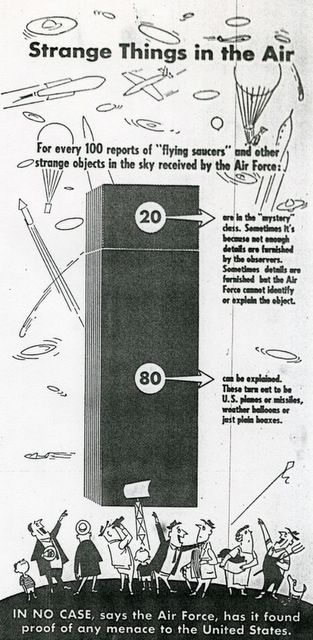
"Amazing and mysterious things are happening in the skies over the United States... After five years of 'saucer' reports, the Air Force still is unable to explain, with conclusive information, one out of five strange sights over the United States. It claims to have solved four out of five reports of fireballs and 'flying saucers' by proving they were such things as planes, balloons, missiles, lights - and several hoaxes."

So said USN, perhaps America's most serious weekly newsmagazine, in a major, three page article on the Flying Saucer (or, as we would say today, the UFO phenomenon), just two weeks after the famous Washington sightings of July 1952, and the subsequent US Air Force press conference that resulted.

To ETH proponents today who long for press coverage, be careful what you wish for. Despite noting that "Strange sights are being seen in the skies - really seen" and that "objects are being picked up by radar that cannot easily be explained," USN concluded that "Men from Mars or other planets are definitely not cruising around above the U.S. No little pixies, flitting around in 'flying saucers,' are surveying beachheads to land explorers from another world." They also stated, categorically, that "space ships are not cruising around, tricking pilots, radar operators, and plain citizens with unknown rays."

Now, I'm not convinced that the ETH is the correct explanation for the UFO phenomenon (or even one of many possible correct explanations), because the evidence is, despite the protestations of today's ETH proponents, not conclusive. But I would never go so far as to dismiss it out of hand, as USN did back in 1952. It is a valid, working hypothesis, despite USN's claim, fifty-three years ago, that the "U.S. isn't being spied on by outlandish contraptions in the heavens."

USN offered a drawing to help people understand what was going on (below):


Of the twenty per cent that were still unidentified, they blithely stated that "there is a sound, reasonable explanation for most of the rest."

"Science and the experts are getting to the bottom of a big and persistent puzzle," claimed USN. The answers would be coming soon.

So... where are they - not only for those unsolved cases back then, but all of the unsolved cases since?

Those who claimed back then - like Donald Keyhoe - that the answer (aliens) was clear were wrong to do so. It was not. But those, like USN, who claimed the same thing, but with a different answer (not aliens), were wrong as well.

The truth is that they didn't know the answer. They believed in an answer, on both sides.

When that happens, the real search for the truth suffers.

Ca plus ca change, ca plus ca meme chose.

Paul Kimball

Tuesday, May 24, 2005

J. Allen Hynek - continued

Rich Reynolds, in a comment to "J. Allen Hynek - Not an Apologist Ufologist," suggests that Dr. Hynek was discredited by his swamp gas explanation for a sighting in Michigan. I agree that the swamp gas explanation was a blow to Dr. Hynek, but, as I said in the post, nobody is perfect. Everybody makes mistakes.

For example, Kevin Randle for years supported Frank Kaufmann's testimony regarding Roswell. Similarly, Stan Friedman supported Gerald Andersen's. Both men have since been discredited. Are Stan and Kevin still respected UFO researchers? Most people would say yes, including, I'm sure, Rich.

Or how about MJ-12? Yes, there are still a few people out there besides Stan who believe the MJ-12 documents are authentic, but not many. Rich himself has stated that the documents are probably bogus. And yet, he still holds Stan in high regard, as he should. Why? Because good people sometimes make bad mistakes.

Leaving the field of ufology for a moment, here's just a couple of "mistakes" (a few of my personal favourites) from which people have recovered, and which were far more egregious than Dr. Hynek's "swamp gas" explanation:

1. Churchill and Gallipoli / Dardanelles campaign (etc etc);

2. Mountbatten and Dieppe;

3. Sir John Barrow and... well, you name it (see the book "Barrow's Boys");

4. Darwin and the Theory of Evolution (just kidding!).

5. Me and... well, too numerous to mention.

The point is that a person should usually not be judged by one incident alone, unless that one incident is so beyond the pale that it really does overshadow everything else (like Ted Kennedy at Chappaquiddick... er, wait. He's still a Senator isn't he? Note to self - above rule apparently does not apply to the Kennedy family). A person is judged by the totality of his or her life, and work. With that in mind, Hynek deserves his place as one of the two or three greatest ufologists (as was made clear to the general public in the ABC News "Seeing is Believing" special).

Perhaps his impact can best be seen in the following letter, which appeared in the issue of Science (Vol. 154 (Pt.2), Nov. - Dec. 1966, p. 1118) published immediately after the one in which Hynek's "UFO's Merit Scientific Study" letter was printed:

"A 1953 Sighting

Hynek's letter (21 Oct.) makes me feel better. As a fishery biologist, I have almost felt ashamed that I, too, among other scientists, have seen a 'flying saucer.' In the fall of 1953 in the eastern panhandle of West Virginia, it was there on the horizon, about a mile away - looked 20 to 30 feet (6 to 9 m) in diameter - glistening in the crystal-clear sunny afternoon. It moved vertically from an on-the-horizon position, then to the left, to the right, and finally descended to the horizon. Then with phenomenal speed it took off to the right on a high sweeping curve out of sight. In my car with me were two other fishery biologists, who saw what I saw and we all agreed it was the 'flying saucer' often described in the press that year, and probably what a doctor in that part of West Virginia had been reporting. I suggested we report it, but one of my assistants felt it mught be classified as 'fishy' since it was from three fishery biologists! One of the viewers was a former P-38 pilot.

The result of a scientist's reluctance to report such sightings is that these incidents remain merely conversational comment at parties. Now I feel relieved that Hynek has given the scientific observer freedom to talk about those crazy flying machines. [emphasis added]

Elwood. A. Seaman
American Fisheries Society
Washington, D.C."

Seaman fit Hynek's description of a "scientifically trained person" who was "reliable, stable and educated. He had his sighting one year after he had served as President of the Northeastern Division of the AFS, and in 1988, after a distinguished career, won the AFS's Meritorious Service Award.

This is just the kind of person that Hynek, in his October, 1966 letter, encouraged to come forward. That is the other side of truth about Dr. J. Allen Hynek, and his true legacy - swamp gas or no swamp gas. If his reputation has suffered in the years since, then it's time to restore some proper perspective.

Paul Kimball

Monday, May 23, 2005

J. Allen Hynek - Not an Apologist Ufologist

Almost forty years ago, Dr. J. Allen Hynek (below), following the announcement that the Air Force had contracted the University of Colorado to conduct a "serious, objective, scientific and independent investigation" of the UFO phenomenon, under the direction of physicist Dr. Edward Condon, wrote the following letter to Science (Vol. 154 (Pt. 1), 21 October 1966, p. 329).


"UFO's Merit Scientific Study

Twenty years after the first public furor over UFO's (called 'flying saucers' then) reports of UFO's continue to accumulate. The Air Force has now decided to give increased scientific attention to the UFO phenomenon. Thus I feel under some obligation to report to my scientific colleagues, who could not be expected to keep up with so seemingly bizarre a field, the gist of my experience in 'monitoring the noise level' over the years in my capacity as scientific consultant to the Air Force. In doing so, I feel somewhat like a traveler to exotic lands and faraway places, who discharges his obligation to those who stayed at home by telling them of the strange ways of the natives.

During my long period of association with reports of strange things in the sky, I expected that each lull in the receipt of reports signaled the end of the episode, only to see the activity renew; in just the past two years it has risen to a new high. Despite the fact that the great majority of the reports resulted from misidentifications of otherwise familiar things, my own concern and sense of personal responsibility have increased and caused me to urge the initiation of a meaningful scientific investigation of the residue of puzzling cases by physical and social scientists. I have guardedly raised this suggestion in the literature [Note - J. Opt. Soc. Amer. 43, 311 (1953)] and at various official hearings, but with little success. UFO was a term that called forth buffoonery and caustic banter; this was both a cause and an effect of the lack of scientific attention. I speak here only of the puzzling reports; there is little point to concern ourselves with reports that can be easily traced to weather ballons, satellites, and meteors. Neither is there any point to take account of vague oral or written reports which contain few information bits. We need only be concerned with 'hard data,' defined here as reports, made by several responsible witnesses, of sightings which lasted a reasonable length of time and which were reported in a coherent manner.

I have strongly urged the Air Force to ask physical and social scientists of stature to make a respectable, scholarly study of the UFO phenomenon. Now that the first firm steps have been taken towards such a study, I can set forth something of what I have learned, particularly as it relates to frequently made misstatements about UFO's. Some of these statements which lead to misconceptions are:

1) Only UFO 'buffs' report UFO's. The exact opposite is much nearer the truth. Only a negligible handful of reports submitted to the Air Force are from 'true believers,' the same who attend UFO conventions and who are members of 'gee-whiz' groups. It has been my experience that quite generally the truly puzzling reports come from people who have not given much or any thought to UFO's.

2. UFO's are reported by unreliable, unstable, and uneducated people. This is, of course, true. But UFO's are reported in even greater numbers by reliable, stable, and educated people. The most articulate reports come from obviously intelligent observers; dullards rarely overcome their inherent inertia toward making written reports.

3) UFO's are never reported by scientifically trained people. This is unequivocally false. Some of the very best, most coherent reports have come from scientifically trained people. It is true that scientists are reluctant to make a public report. They also usually request anonymity which is always granted.

4) UFO's are never seen at close range and are always reported vaguely. When we speak of the body of puzzling reports, we exclude all those which fit the above description. I have in my files several hundred reports which are fine brain teasers and could easily be made the subject of profitable discussion among physical and social scientists alike.

5) The Air Force has no evidence that UFO's are extra-terrestrial or represent advanced technology of any kind. This is a true statement but is widely interpreted to mean that there is evidence against the two hypotheses. As long as there are 'unidentifieds,' the question must obviously remain open. If we knew what they were, they would no longer be UFO's - they would be IFO's, Identified Flying Objects! If you know the answer beforehand, it isn't research. No truly scientific investigation of the UFO phenomenon has ever been undertaken. Are we making the same mistake the French Academy of Sciences made when they dismissed stories of 'stones' that fell from the sky? Finally, however, meteorites were made respectable in the eyes of science.

6) UFO reports are generated by publicity. One cannot deny that there is a positive feedback, a stimulated emission of reports, when sightings are widely publicized, but it is unwarranted to assert that it is the sole cause of high incidence of UFO reports.

7) UFO's have never been sighted on radar or photographed by meteor or satellite tracking cameras. This statement is not equivalent to saying that radar, meteor cameras, and satellite tracking stations have not picked up 'oddities' on their scopes or films that have remained unidentified. It has been lightly assumed that although unidentified, the oddities were not unidentifiable as conventional objects.

For these reasons, I cannot dismiss the UFO phenomenon with a shrug. The 'hard data' cases contain frequent allusions to recurrent kinematic, geometric, and luminescent characteristics. I have begun to feel that there is a tendency in 20th-century science to forget that there will be a 21st-century science, and indeed, a 30th-century science, from which vantage points our knowledge of the universe may appear quite different. We suffer, perhaps, from temporal provincialism, a form of arrogance that has always irritated posterity.

J. Allen Hynek
Dearborn Observatory, Northwestern University
Evanston, Illinois"

This is one of the most rational, balanced, and reasoned, and therefore compelling, statements of the need for the physical and social sciences to seriously study the UFO phenomenon ever made.

Hynek was no "apologist ufologist," a term that has been applied to him by some within modern ufology, usually proponents of the Extraterrestrial Hypothesis who contend - incorrectly - that if you do not accept the ETH as ETF (Extraterrestrial Fact), then you can' t be a ufologist. Don't get me wrong - Hynek was far from perfect. But isn't everyone? The fact is that he remains, almost twenty years after his death in 1986, one of the two or three leading lights in the history of the study of the UFO phenomenon. He charted a reasonable path for the exploration of the phenomenon. That ufology has seemingly chosen, in many respects, to not follow that path, says more about ufology than it does Dr. Hynek, and answers, to a large degree, the question of why serious academics of both the physical and social sciences have, unfortunately, largely ignored Hynek's call to action to this day.

Paul Kimball

Friday, May 20, 2005

Beware The Links Between Conspiracy Theory and Anti-Semitism

Does the poster below offend you?

It should.

It is a symbol of the anti-Semitism in Nazi Germany that led directly to the Holocaust.


What, you may ask, does this have to do with the study of the UFO phenomenon? Unfortunately, more than you might think.

Jeff Rense has a very popular talk radio show, and an affiliated website, that are looked to by a lot of people for information about the UFO phenomenon, conspiracy theories, and other paranormal subjects.

However, that’s not all you get at http://www.rense.com/. In the past three weeks, for example, you will find the following “columns” –

1. 17 May – “Auschwitz Dead – From Four to 1 + Million – Or Less!” (www.rense.com/general65/aauc.htm) by Dick Fojut, who refers to the Holocaust as “the Aushwitz-Holocaust ‘legend’” and urges readers to “decide for yourselves whether the greater claim of 6 million murdered Jews is also false – or (to politically benefit the State of Israel) has been enormously exaggerated…”

2. 17 May – “Anne Frank’s Diary – Some Honest Questions.” (www.rense.com/general65/aan.htm) It makes the outrageous claims that the Diary was “very substantially adapted and enlarged [by Otto Frank] for financial gain” and that the result is “a fraudulent document… which helps promote sympathy for Zionism.”

3. 13 May 2005 – “The Holocaust Belongs to All of Us” by Jana Janus (www.rense.com/65/hol.htm) which includes the following “reportage” – “World War II and the Holocaust seem to have become the exclusive property of the Jews. They dictate what the facts are. They make the documentaries and the films about it. They control the publishing industry that prints the books and the textbooks on this subject. They get to tell everyone what to think about it… The Jews must not be allowed to OWN the Holocaust. They must not be allowed to consider it their exclusive property!”

4. 2 May 2005 – A column with the title “Zundel Update – Two POW Letters from a German Prison” by Ernst Zundel sympathiser Ingrid Rimland (www.rense.com/general64/zundelupdatetwoPOW.htm). For those not aware, Zundel is a notorious Holocaust denier and anti-Semite that Canada had the good sense, after a long legal fight, to deport back to his native Germany. To describe him as a Prisoner of War begs the question – just what war is he fighting, and against whom? Anyone who knows anything about the Zundel case knows the answer to that question.

This isn’t history, or political science.

This isn’t studying the Nazis, or the Holocaust, in order to learn something.

This is Anti-Semitism, plain and simple. It might not be as direct as the poster shown above (although in some cases it is), but that doesn't make it any better. Indeed, it might be even worse - anti-semitism, masquerading as "academic study" and the "free exchange of information." Mac Tonnies, at his excellent blog Posthuman Blues, recently noted the current of anti-Semitism that runs hand in hand these days with those who sit on the fringe of the conspiracy theory-ism (which is itself a fringe - see http://posthumanblues.blogspot.com/2005/05/forteans-as-populist-intellectuals.html). This echoes Jerry Clark, who once wrote, sensibly, “My experience is that if you scratch a conspiracy theorist, a bigot bleeds.”
(www.virtuallystrange.net/ufo/updates/1999/may/m14-002.shtml)

William Cooper was an excellent example (Michael Salla, take note).

Unfortunately, so are the postings that can be found at Rense’s website.

Now, Rense sticks a disclaimer on his website that states, in part:

"The posting of stories, commentaries, reports, documents and links (embedded or otherwise) on this site does not in any way, shape or form, implied or otherwise, necessarily express or suggest endorsement or support of any such posted material or parts therein."

The full disclaimer can be seen at www.rense.com.

No disclaimer, however, is sufficient to evade responsibility for providing a forum for this kind of material. It is not a question of freedom of speech (the cloak of intellectual respectability that Rense seeks to wrap himself in); it is a question of knowing right from wrong.

Rense’s disclaimer is moral cowardice - at best.

At worst?

Well, sometimes you are known by the company you keep.

Ufologists have a responsibility to inform themselves of stuff like this, and then walk away from any invite to appear on Rense’s show. I know whereof I speak – a few months ago, I appeared on his show to talk about the Aztec case. I assumed he was just another radio host, and it was just another show, like SDI. I now know different, and I regret appearing on his show. I will not do so again, and I urge everyone in the UFO field to follow suit.

I've spent years, in and out of university, studying the Nazis, the Second World War, and the Holocaust. I take to heart the words of Martin Niemoller, a decorated WWI submarine commander who became a Protestant pastor and anti-Nazi (he spent the war in a concentration camp), and who wrote, after the war:

“First they came for the communists, and I did not speak out - because I was not a communist; Then they came for the socialists, and I did not speak out - because I was not a socialist; Then they came for the trade unionists, and I did not speak out - because I was not a trade unionist; Then they came for the Jews, and I did not speak out - because I was not a Jew; Then they came for me - and there was no one left to speak out.”

We must never forget, and we must never hesitate to speak out.

That's my disclaimer.

Paul Kimball

For information on the Holocaust, see www.pbs.org/auschwitz/, www.ushmm.org (the United States Holocaust Memorial Museum site), www.vhf.org (Survivors of the SHOAH Visual History Foundation), and www.remember.org - all four are good starting points. Also, check your local video store for two films - The Wannsee Conference, and Conspiracy. And, of course, Schindler's List. For reading material, a good place to start would be with the testimony from the Nuremberg Trial, which can be found at most law libraries.